
Published for: Fleet mechanics, repair shops, international truck parts buyers, and heavy-duty aftermarket technicians who service Chinese domestic heavy trucks (FAW, SINOTRUK, SHACMAN, Dongfeng).
Key Focus: Exact HCV mounting positions per truck model + common installation mistakes + professional aftermarket replacement tips
Introduction
The height control valve (HCV), also known as a leveling valve, is the core regulating component of a heavy truck’s air suspension system. It automatically inflates and deflates chassis and cab air bags according to cargo load changes, maintaining standard ride height, stabilizing driving handling, reducing chassis vibration, and protecting air springs and suspension parts.
For Chinese heavy-duty trucks including FAW Jiefang, SINOTRUK HOWO, Shacman, and Dongfeng, the HCV is a high-frequency wearing part. For maintenance teams and parts suppliers, confirming the exact HCV location is the first step to accurate troubleshooting and correct part matching. Different from European and American trucks, Chinese mainstream heavy trucks have fixed, standardized HCV installation positions, which greatly improves replacement efficiency—once you master the model rules, you can avoid matching errors, returns, and repeated disassembly.
General Standard HCV Location on Chinese Heavy Trucks
All mainstream domestic heavy-duty truck models follow a unified OEM layout standard for height control valves. There are two independent HCV systems on almost every vehicle: chassis suspension HCV and cab suspension HCV. The two parts are structurally different and cannot be used interchangeably.
Universal Core Installation Rule:
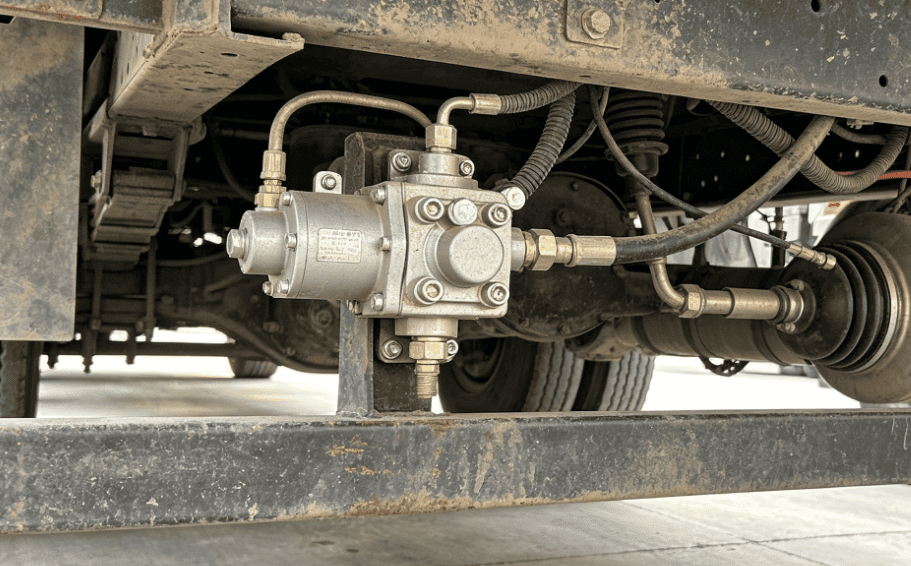
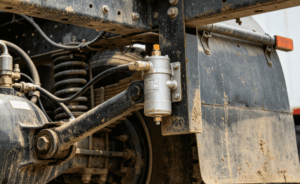
The chassis height control valve is mostly mounted on the inner side of the right rear frame rail, close to the rear drive axle or tandem axle air bag assembly. It is fixed on a dedicated OEM bracket and connected to the axle housing via a rigid linkage rod and swing arm, sensing real-time height changes between the frame and axle.
This unified domestic design features simple structure, easy disassembly, and strong universality, which is more friendly for aftermarket maintenance and parts replacement compared with imported trucks.
Model-Specific HCV Location (FAW / SINOTRUK / SHACMAN / DONGFENG)
Each Chinese heavy truck brand has its exclusive HCV layout characteristics. Mastering the following model-specific positions allows 100% accurate part selection for replacement and procurement.
1. FAW Jiefang Series (J6P / JH6 / J7 / J6V)
As the most widely used domestic heavy truck series, Jiefang features highly standardized HCV installation:
-
Chassis HCV: Installed on the inner side of the right rear frame rail, between the front and rear tandem axles and close to the rear air bag assembly. Classic J6P adopts a standard single-valve layout, while upgraded JH6 and J7 models use an optimized short-stroke linkage structure for more sensitive height adjustment.
-
Cab HCV: Mounted on the front suspension crossbeam under the cab with independent left and right valves. It is completely different from the chassis HCV in structure and parameters, and cross installation will cause cab tilt and air leakage.
2. SINOTRUK HOWO Series (HOWO-7 / MAX / TH7)
-
Chassis HCV: Fixed on the right frame rail behind the rear drive axle, perfectly matched with Fuwa domestic air suspension. The installation position is compact with concentrated air line interfaces, enabling fast one-person replacement and maintenance.
-
Cab HCV: Adopts an integrated single-valve design, installed on the rear bracket of the cab suspension. It is applicable to most HOWO standard tractors and cargo trucks with stable adjustment performance.
3. Shacman Series (X3000 / F3000 / M3000)
Shacman has the most distinctive HCV layout among domestic heavy trucks:
-
Chassis HCV: Symmetrical dual-valve layout on the inner sides of left and right rear frame rails, with independent height control for tandem axles. This dual-valve structure is exclusive to Shacman, requiring strict model matching during part replacement.
-
Cab HCV: Concentratedly installed on the middle beam of the cab front suspension, equipped with a long swing arm linkage to ensure ultra-sensitive height induction.
4. Dongfeng Commercial Vehicle Series (KL / KR / VL)
-
Chassis HCV: Located on the right frame rail of the rear suspension, integrated with the suspension limit bracket. The compact structure adapts to Dongfeng’s self-developed air suspension system with high fitting accuracy.
-
Cab HCV: Adopts front and rear separate layout, with stable inflation and deflation logic, and strong versatility in Dongfeng medium and heavy-duty truck models.
4 Core Identification Features of Domestic Heavy Truck HCV
To distinguish domestic high-quality HCV replacement parts and avoid mismatching, you can quickly identify them through four fixed characteristics:
-
Fixed installation direction: Uniform standard of top air inlet and bottom exhaust port; the valve body cannot be installed reversely or rotated arbitrarily.
-
Standard swing arm stroke: The linkage swing angle is fixed at 30°–45°, perfectly matching the stroke parameters of domestic truck air bags, effectively preventing ride height deviation after replacement.
-
Unified interface specification: Most Chinese heavy truck HCVs adopt 1/4-inch air line interfaces, with high universality among mainstream domestic brands.
-
Absolute independence of dual systems: Cab HCV and chassis HCV have no versatility. Cross use will directly cause continuous air leakage, vehicle tilt, and abnormal suspension height.
Professional Aftermarket Replacement & Sales Tips
For heavy truck parts dealers and maintenance technicians, HCV location judgment directly determines service quality and after-sales rate. Here are the most practical industry insights:
-
Distinguish chassis and cab valves first: More than 80% of HCV replacement errors come from confusing these two parts. Always confirm the vehicle’s installation position before ordering parts.
-
Brand-specific matching is mandatory: FAW, HOWO, Shacman, and Dongfeng HCVs have exclusive structural differences in bracket size and linkage length. Generic parts may fail to install or work abnormally.
-
Calibrate ride height after replacement: After installing a new HCV, follow domestic OEM standard parameters for height calibration to solve common problems such as uneven body height and frequent air bag inflation.
-
High demand for regular replacement: For domestic heavy trucks engaged in long-distance heavy-load transportation, HCV swing arms are prone to aging and jamming, leading to air leakage. It is a stable high-consumption aftermarket part with long-term market demand.
Final Conclusion
Unlike imported heavy trucks with scattered layouts, Chinese mainstream heavy-duty trucks have standardized, brand-fixed HCV installation positions. Skilled mastery of HCV locations for FAW, SINOTRUK, Shacman, and Dongfeng models helps maintenance teams greatly improve repair efficiency and eliminate misdiagnosis. For truck parts suppliers, professional model matching knowledge and high-quality dedicated domestic HCV parts are the core of winning long-term fleet and repair shop cooperation.
If you need reliable OEM-quality height control valves for Chinese heavy trucks, professional model matching support is always available.
111