Trailer brake failures don't announce themselves at the depot — they announce themselves on a loaded downhill run. If you've just received a shipment of trailer units and your first brake test is a drive around the yard, you're checking the wrong things. This article gives you a structured arrival sequence that catches the failures a drive test misses entirely.
Testing a trailer brake system means verifying three things in order: that air pressure builds to the working range within the expected time, that pressure holds stable with the engine off and brakes applied, and that the brake chamber pushrods are within their rated stroke. A drive impression tells you none of this. Those three checks are what a buyer can perform at delivery — anything beyond them requires workshop lifting equipment and a qualified technician.
The logic behind that sequence matters as much as the steps themselves. Understanding why each check catches a different failure mode will help you decide what to do next — and when to stop and call a workshop instead of putting the trailer into service.
Why "It Stops" Is Not a Brake Test
Most buyers arrive at a trailer and do the same thing: they pressurize the system, apply the pedal, and confirm the vehicle decelerates. If it stops, they move on. This is the most common and most dangerous shortcut in pre-service trailer inspection.
Stopping distance is a lagging indicator. By the time stopping performance degrades enough to notice during a yard drive, several upstream failures are usually already present — slow pressure build, a slow internal leak, overextended pushrods, or a partially blocked air dryer. The vehicle stops, but it stops with almost no safety margin remaining. [1]
Two specific beliefs that cause this mistake
Belief 1: "The pedal works, so the system is fine." Pedal response confirms the control circuit. It says nothing about how quickly the air reservoir reached working pressure, whether that pressure is holding, or whether the spring brakes will release and re-engage correctly under full load.
Belief 2: "The gauge reads normal, so there's no leak." A gauge showing working pressure can coexist with a slow leak. The question is not what the gauge reads when the engine is running — it's whether the gauge reading stays stable for 60 to 90 seconds after the engine stops and brakes are applied. A system that bleeds slowly will read fine during a running test and fail you on a long descent.
In our pre-shipment checks at Caanass, these two failure patterns — slow bleed-down and overextended stroke — appear on otherwise presentable trailers with some regularity. They are invisible on a drive test and straightforward to find once you know the sequence.
The Two Checks a Buyer Can Do on Arrival
Before you book a workshop bay, there are exactly two checks you can perform yourself at the delivery point with minimal equipment: an air system pressure check (build-up time and static hold) and a visual pushrod stroke measurement. Everything else — lining thickness, internal valve condition, ABS sensor calibration — requires equipment you won't have at a yard.
These two checks are not a substitute for a workshop inspection. They are a triage tool. They tell you whether the trailer is safe to move to a workshop under its own power, or whether it needs to go on a flatbed.
Air Pressure: Build-Up Time and Static Leak-Down
A healthy air brake system builds pressure from low to the working range in a predictable window once the engine is running. The acceptable build-up time varies by system configuration, so confirm the expected window against your trailer manufacturer's documentation before you start.
What you observe: start the engine and watch the gauge. Note how long it takes to reach the working range. A system that takes noticeably longer than expected suggests a restriction, a leak during fill, or a worn compressor. A system that builds pressure but drops immediately when the engine stops confirms an active leak.
How to run a static leak-down check
- Build air pressure to the normal working range with the engine running.
- Shut the engine off.
- Apply the service brakes fully and hold them.
- Watch the gauge for 60 to 90 seconds without releasing.
- Note how much pressure the gauge loses during that window.
A well-sealed system holds pressure with minimal movement during this window. Any consistent drop — especially a drop that continues rather than stabilizing — indicates a leak somewhere in the system. The acceptable threshold for pressure drop must be confirmed against your trailer manufacturer's documentation, as tolerances vary by system design. What matters observationally is whether the gauge stabilizes or continues to fall.
The air drying chamber (reference WG9000360521) is worth checking visually during this step. The air dryer sits in the supply line before the reservoirs. If it is saturated, cracked at a fitting, or leaking at the purge valve, it contributes to both slow build-up and poor moisture control — which degrades valves over time.
Pushrod Stroke: Reading the Chamber
Brake chamber pushrod stroke is the single most useful visual check a buyer can perform without tools. It directly reveals whether the foundation brake — the lining, drum, and adjuster — is consuming the chamber's available travel.
What overextended stroke means
Each brake chamber has a rated stroke limit. When the pushrod extends further than that limit during a full brake application, it means the slack adjuster can no longer compensate for lining wear. The brake still fires — air still moves the diaphragm — but the mechanical advantage has degraded. Under load on a grade, you have less braking force than the gauge implies. [3]
How to measure it
- With the system pressurized to working pressure and brakes released, mark the pushrod at the face of the chamber with a paint marker or chalk line.
- Apply full service brake pressure.
- Measure the distance the pushrod moved from your mark.
- Compare against the rated stroke limit stamped on the chamber or listed in the manufacturer specification for that chamber size.
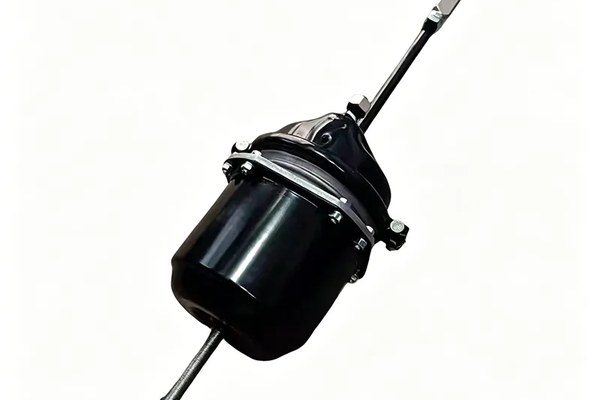
Most spring brake chambers (see reference 35309020400) have the stroke rating cast or stamped on the body. If the measured stroke equals or exceeds the rated limit, the trailer needs foundation brake service before it enters revenue service — not after. [2]
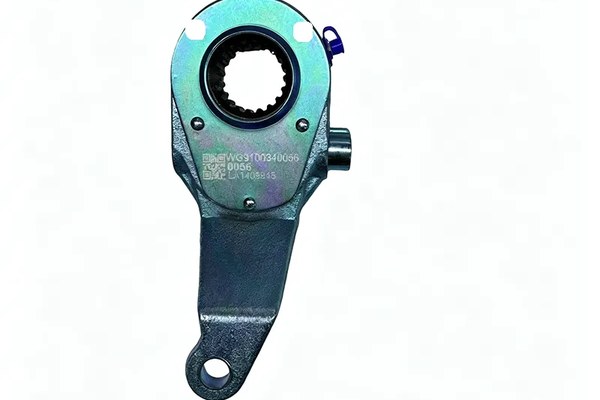
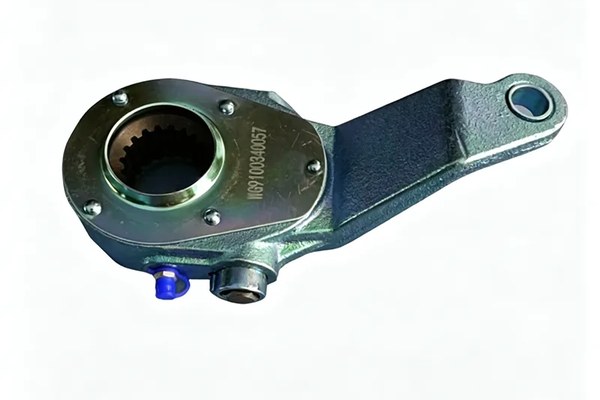
The slack adjusters (references WG9100340056 for left-hand and WG9100340057 for right-hand) are the components that take up lining wear automatically. If a pushrod is overextended, inspect the slack adjuster first: confirm it is turning freely on adjustment, that the worm gear engages cleanly, and that there is no visible corrosion locking the mechanism.
Which Failures Are Parts Problems and Which Are Not
Not every brake failure means you need new parts. This distinction matters for cost, time, and decision-making.
| Symptom | Likely cause | Parts or service? |
|---|---|---|
| Pressure builds slowly, holds well | Air dryer restriction or worn compressor | Parts (dryer) or service (compressor) |
| Pressure drops continuously after engine off | Fitting leak, valve seat wear, or cracked hose | Parts + fitting service |
| Pushrod at or beyond stroke limit | Worn lining or seized slack adjuster | Parts (lining, adjuster) |
| Spring brake won't release | Broken spring or seized internal chamber | Parts (chamber) |
| Brakes pull to one side | Mismatched stroke across axle ends | Service + adjuster check |
Identifying whether a failure is a worn-out part or a maintenance backlog item (seized mechanism, corroded fitting) helps you scope the repair before the trailer enters a workshop bay.
Reference Numbers We Stock
The parts below are the components most commonly involved in the failures this article describes. All are available through the Caanass product catalogue.
| Reference | What it is | Where it fails first |
|---|---|---|
| 35309020400 | Spring brake chamber | Diaphragm crack or pushrod seal leak under repeated cycling |
| WG9100340056 | Left slack adjuster | Worm gear corrosion or one-way clutch seizure |
| WG9100340057 | Right slack adjuster | Same failure modes as left; replaced as a pair |
| WG9000360521 | Air drying chamber | Desiccant saturation causing moisture pass-through |
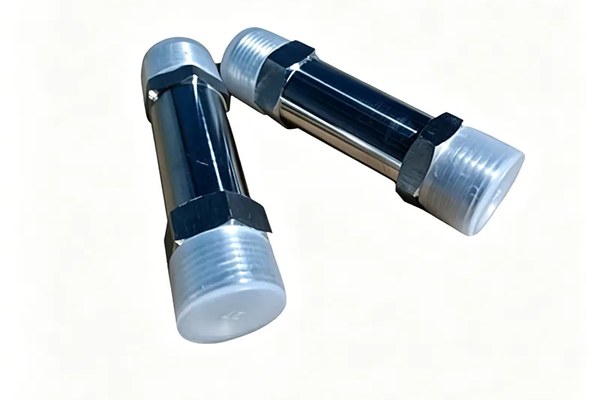
| YZ952555003085/4 | Return air shut-off valve | Seat wear causing reverse flow or incomplete shut-off |
When to Stop and Call a Workshop
Self-inspection has a hard ceiling. The two checks above are reliable triage tools. They are not a clearance certificate. Stop the self-inspection and call a qualified workshop if any of the following are true:
- Pressure drops continuously and you cannot locate the leak point visually
- Pushrod stroke meets or exceeds the rated chamber limit on any axle end
- The spring brake does not release fully when supply pressure is applied
- Brakes apply unevenly across the axle — one side drags while the other releases freely
- You find moisture, oil contamination, or corrosion at any brake chamber fitting
- ABS warning lights remain active after system pressurization
Do not attempt to bleed, adjust, or disassemble spring brake chambers without the correct caging tool and professional guidance. Compressed spring energy inside a malfunctioning chamber is a serious physical hazard.
Frequently Asked Questions
How long should a trailer air system take to build pressure from low to working range?
Build-up time varies by system size, compressor rating, and reservoir volume. The specific acceptable window for your trailer is defined in the manufacturer's documentation. What you are watching for is whether the system builds smoothly and consistently — a system that stalls partway or climbs very slowly signals a restriction or active leak.
Can I test trailer brakes without a tractor unit?
A full air pressure test requires a supply source — either a connected tractor unit or a shop compressor with the correct coupling. Without pressurized air, you can only perform visual checks: pushrod position at rest, fitting condition, chamber body condition, and slack adjuster movement. Visual checks alone are not sufficient to clear a trailer for service.
What is the difference between a service brake chamber and a spring brake chamber?
A service brake chamber applies the brakes when air pressure is added. A spring brake chamber (piggyback or combination type) applies the brakes by spring force when air pressure is removed — this is the parking and emergency brake function. Most trailer axles use combination spring brake chambers that handle both functions. Reference 35309020400 is a spring brake chamber of this type.
How often should slack adjusters be replaced?
Automatic slack adjusters do not have a fixed replacement interval — they are replaced when adjustment range is exhausted, internal mechanism is seized, or stroke measurements show they are no longer compensating correctly. If a pushrod is overextended after a manual back-off and re-adjustment attempt, the slack adjuster is typically the first component to replace before re-measuring stroke.
What does the return air shut-off valve do, and why does it matter for brake testing?
The return air shut-off valve (reference YZ952555003085/4) prevents reverse airflow in the supply circuit. When it fails — typically through seat wear — it allows air to bleed back through the supply line during static hold, producing a leak-down reading that resembles a reservoir or chamber leak. If your static hold test shows pressure loss but you cannot find an external leak, this valve is a primary suspect.
Conclusion
Testing a trailer brake system is not a drive impression — it is a structured sequence. Build-up time and static hold tell you whether the air circuit is sealed. Pushrod stroke tells you whether the foundation brake has usable travel remaining. Those two checks are within reach of any buyer at the delivery point, with no specialist equipment. Beyond those checks, qualified workshop inspection is the only reliable path to clearance for loaded road service. Use the arrival checklist below before the trailer leaves your yard, and treat any failure indicator as a reason to stop — not a reason to monitor.
Arrival Checklist: 5 Steps Before the Trailer Moves
- Confirm pressure build-up time — engine on, watch the gauge climb to working range, note if the speed is consistent with the manufacturer's specification.
- Run a static leak-down check — engine off, brakes applied, gauge watched for 60 to 90 seconds; note whether pressure stabilizes or continues to fall.
- Measure pushrod stroke on every axle end — apply full service pressure, measure travel from rest position to full application, compare against the rated stroke limit for the chamber.
- Inspect slack adjusters visually — confirm free rotation, no visible corrosion on the worm, no physical damage to the adjuster body.
- Check air dryer and shut-off valve fittings — look for moisture at the purge port, oil contamination at inlet fittings, and any sign of cracking or sealing compound repair at the return air valve connection.
References
[1] U.S. Government Publishing Office, 49 CFR 393.48 "Brakes to be operative" — https://www.law.cornell.edu/cfr/text/49/393.48 — Evidence role: regulatory requirement that brakes must be operative at all times; source type: primary regulation; Supports: the article's claim that a trailer that "stops" is not automatically compliant; Scope note: U.S. federal requirement, local rules may differ.
[2] U.S. Government Publishing Office, 49 CFR 396.3 "Inspection, repair, and maintenance" — https://www.law.cornell.edu/cfr/text/49/396.3 — Evidence role: requirement to keep inspection and maintenance records; source type: primary regulation; Supports: the article's advice to record VIN, chamber references and stroke readings; Scope note: U.S. federal requirement, applied here as a record-keeping principle.
[3] U.S. Government Publishing Office, 49 CFR 571.121 "Air brake systems" — https://www.law.cornell.edu/cfr/text/49/571.121 — Evidence role: federal performance requirements for air brake systems on heavy vehicles, including service brake actuation and reservoir performance; source type: primary regulation; Supports: the article's claim that brake chamber stroke is a rated limit and not an arbitrary visual impression; Scope note: U.S. federal standard for new vehicles, used here as a reference point for what a properly performing air system should do.
Image credits
All photographs are our own product and warehouse photographs of parts we stock. No third-party images are used.