Why the working principle decides which part you order
Air brake system working principle is one of those topics that buyers assume they can skip — until a mismatched chamber arrives in Lagos or Nairobi and a loaded dump truck can't generate enough clamping force to stop safely. We've seen exactly that scenario more than once in the inquiries we handle at Caanass: the port size matched, the physical dimensions looked right, but the pressure rating was lower than the OEM spec, and the result was dangerously reduced braking performance under full load.
That asymmetric risk is the reason this article exists. A wrong fuel injector hurts efficiency. A wrong brake component can cause brake failure at 60 km/h with 30 tonnes behind the cab. Understanding how air pressure moves through the circuit — from compressor to chamber — is not an academic exercise. It is the minimum knowledge you need to verify that the part you're ordering will actually function in your specific truck's circuit.
The working principle is also the fastest way to explain why the same-looking valve or chamber from two different OEM sources can behave completely differently. Identical dimensions do not mean identical function. The circuit has a logic, and every component must match that logic or the whole system degrades.
The five components that do the work
Before you can evaluate a part number, you need a clear picture of where each component sits in the circuit and what it is responsible for. A fault or mismatch at any stage propagates downstream — that's the nature of a pneumatic circuit.
1. Compressor
The compressor is driven off the engine and feeds compressed air into the system. It doesn't control braking directly, but insufficient output pressure (caused by worn rings or a faulty unloader valve) starves the entire circuit. If a truck takes unusually long to build up air pressure after startup, the compressor is the first place to investigate.
2. Air dryer and reservoir
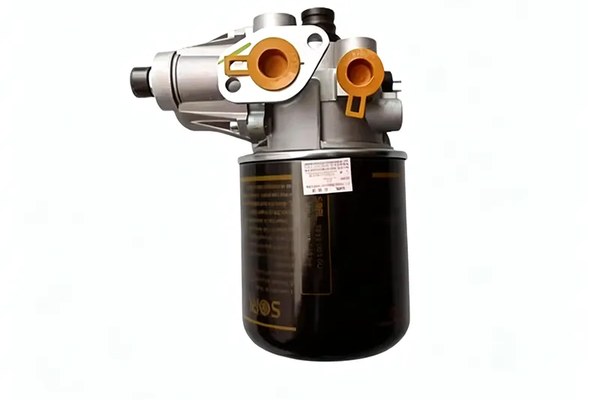
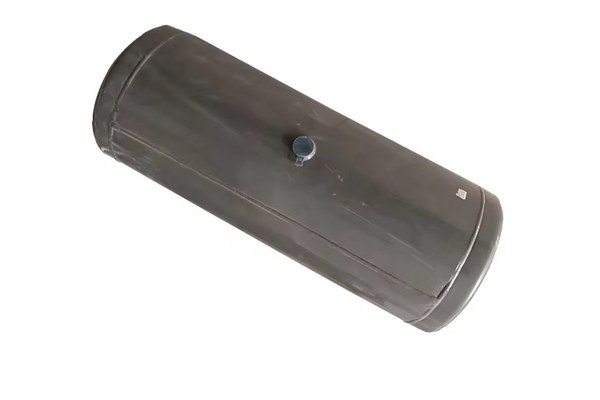
The air dryer strips moisture and oil vapor before air reaches the valves and chambers. Contaminated air accelerates diaphragm wear in the chambers and causes valve seats to corrode. The reservoir stores a volume of compressed air large enough to deliver multiple full brake applications — even if the compressor temporarily can't keep up.
For HOWO applications, Caanass stocks the 35110070840 Air Dryer (without four-circuit protection valve) and the WG9000360713 Air Reservoir. Both references must be confirmed against your specific vehicle before ordering.
3. Valve block (foot brake valve, relay valves, protection valve)
This is the most configuration-sensitive section of the circuit. The foot brake valve translates pedal input into a proportional pressure signal. Relay valves amplify that signal closer to the axles. The four-circuit protection valve isolates each sub-circuit so that a failure in one line — say, a burst hose to the trailer — doesn't depressurize the entire system.
The CK9000360523 Four-Circuit Protection Valve we stock is a commonly requested reference for HOWO trucks. Even within the HOWO range, buyers should confirm the cracking pressure settings match their vehicle's system design.[1]
4. Brake chamber
The chamber converts air pressure into mechanical force at the wheel end. Service chambers handle normal braking. Spring brake chambers (also called spring-and-diaphragm or "piggyback" units) add a coiled spring that applies the brakes automatically if air pressure is lost — this is the parking and emergency function. The spring in a spring brake chamber stores a significant amount of mechanical energy and must never be disassembled in the field without proper tools.
5. Slack adjuster
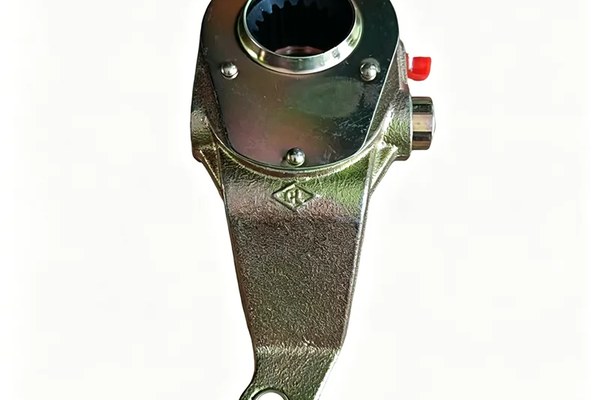
The slack adjuster links the chamber pushrod to the brake camshaft. As brake linings wear, the slack adjuster (automatic or manual) maintains the correct pushrod stroke. If the stroke is too long, the chamber reaches the end of its travel before full clamping force is generated. Stroke length is therefore a critical verification item for any chamber replacement.
Where the same-looking parts differ across configurations
This is the section most buyers under-read — and the one that causes the most expensive mistakes.
Air brake components across brands and even model years within the same brand can share identical thread sizes, port diameters, and bolt patterns while having completely different internal specs. In the inquiries we handle, the most common mismatch categories are:
- Pressure rating. A chamber rated for a lower working pressure than the system delivers will produce less clamping force and wear out faster. A valve rated for a lower cracking pressure will open at the wrong point in the pedal travel.
- Chamber stroke length. This varies by axle type (steer, drive, trailer), by vehicle GVW, and by OEM. A chamber with a shorter stroke than specified will run out of travel before the linings fully contact the drum.
- Port size and thread standard. Metric and imperial fittings can appear visually similar. A fitting that is not fully threaded to spec will leak under vibration.
- Spring brake spring force. The spring in a piggyback unit is sized to hold a loaded vehicle on a gradient. A spring with insufficient force is a hidden risk that only appears when the truck is parked on a slope with a full load.[2]
- Relay valve response curve. Different OEMs tune relay valves to respond faster or slower depending on the axle configuration. A valve with the wrong response curve can cause front/rear brake timing imbalance.
Tractor-trailer configurations add another layer. The WG9000360525 Trailer Control Valve and the WG2203250003 Double H Valve are circuit-specific components. Substituting one for a visually similar unit from a different OEM without verifying the pressure logic is a risk we advise against strongly.
Buyers sourcing for mixed fleets — say, a mix of HOWO T7H units and older HOWO A7 trucks — should not assume the same part number covers both. Configuration changes between model years are real, and a vehicle's service history and VIN are the starting point for any verification.[3]
Component reference table
The table below lists eight references Caanass currently stocks. These are starting points for inquiry — not universal fits. Every reference must be confirmed against the buyer's specific vehicle make, model, and year before an order is placed.
| Component | OEM reference we stock | Where it sits in the circuit | What to verify |
|---|---|---|---|
| Brake Chamber | WG9000360100 | Steer or drive axle, service braking | Stroke length, pressure rating, mounting flange pattern |
| Spring Brake Chamber | 35309020400 | Rear drive axle, park/emergency function | Spring force rating, combined stroke, pushrod clamp type |
| Foot Brake Valve | 35140330050 | Cab, pedal assembly | Delivery pressure range, number of circuits controlled |
| Double H Valve | WG2203250003 | Chassis, between tractor and trailer circuits | Port configuration, response pressure differential |
| Trailer Control Valve | WG9000360525 | Chassis, trailer coupling point | Compatibility with trailer brake circuit type |
| Air Dryer (no 4-circuit valve) | 35110070840 | Between compressor and reservoir | Cartridge regeneration cycle, purge valve condition |
| Four-Circuit Protection Valve | CK9000360523 | Main air supply distribution point | Cracking pressures per circuit, number of ports |
| Air Reservoir Assembly 275mm 40L | WG9000360713 | Main supply tank on frame rail | Volume (liters), working pressure rating, drain valve type |
A pre-shipment checklist for buyers
Before confirming a brake component order — and before the container loads — buyers have consistently told us they wish they had asked for the following:
- Vehicle identification confirmation. Request the full VIN and ask the supplier to cross-reference the part number against that specific VIN, not just the model name.
- Pressure rating documentation. Ask for the working pressure and maximum pressure rating of any chamber, valve, or reservoir you're ordering. Compare this against your vehicle's brake system specification sheet.
- Chamber stroke length. For any brake or spring brake chamber, request the specified pushrod stroke in millimeters and confirm it matches the original.
- Spring force rating for spring brake chambers. Ask for the applied spring force figure. This is not always visible from the part number alone.
- Photo of the original unit removed from the vehicle. A side-by-side photo of the old unit and the replacement unit before packing is one of the most reliable quick-checks available to a remote buyer.
- Confirmation of which sub-configuration the part fits. For HOWO, this means specifying whether it's a 6×4 tractor, 8×4 dump truck, or other variant — axle count and GVW affect which valves and chambers are correct.
- Inspection record or test report. For used or remanufactured components, ask whether a bench pressure test was performed and request documentation.
Frequently Asked Questions
Can I use a spring brake chamber rated for a lighter truck on a heavier GVW vehicle?
We strongly advise against it. In the inquiries we handle, buyers have reported reduced parking hold on loaded vehicles when a spring brake chamber with insufficient spring force was installed. The spring force must correspond to the vehicle's gross vehicle weight and axle load rating. Always verify this spec before ordering.
How do I know if my HOWO truck uses the foot brake valve with one circuit or two?
Check the number of delivery ports on the existing valve. Single-circuit and dual-circuit foot brake valves are not interchangeable — the downstream relay valves and circuit layout are designed around the valve's output configuration. If you don't have the original unit, the vehicle's service manual or wiring/piping diagram will specify the correct type.
What causes slow brake response on an air brake system?
Based on what we've handled, slow response typically points to one of three areas: a low-capacity or worn compressor failing to maintain system pressure, a partially blocked or leaking relay valve slowing pressure delivery to the chambers, or a reservoir that is undersized or contaminated. Isolating which stage is the issue requires a circuit pressure test at each point.
Why does my brake drag even after the pedal is released?
Brake drag in an air system usually means pressure is not fully exhausting from the chamber. The most common causes are a relay valve that is not venting correctly, a seized or sticky slack adjuster, or a service chamber diaphragm that has deformed and is not returning fully. It can also indicate that the foot brake valve is not returning to its full rest position.
Are European brand air brake components (Scania, Volvo, MAN) compatible with HOWO systems?
No. European OEM brake systems use different pressure settings, valve response curves, and connector standards from Chinese OEM trucks like HOWO or SHACMAN. Mixing components across these platforms — even where fittings appear compatible — is a compatibility risk. Source components that are specified and validated for your exact platform.
Conclusion
Air brake system working principle knowledge is a procurement tool, not just a maintenance reference. Every component in the circuit — from the compressor through the dryer, reservoir, valves, chamber, and slack adjuster — has specifications that must match the vehicle's design. A mismatch in any one of them degrades the whole system, and in a brake circuit, that degradation is a safety risk, not just a performance issue.
The references Caanass stocks are verified starting points for HOWO applications. They are not universal fits, and every order should be confirmed against the specific vehicle.
Before your container loads, ask your supplier to confirm and document the following:
- Full VIN and model variant confirmation for each part number
- Working pressure and maximum pressure rating for all chambers and valves
- Chamber stroke length in millimeters
- Spring force rating for any spring brake chamber
- Photo of original removed unit alongside the replacement unit
- Bench pressure test record for any remanufactured component
Browse the full range of verified HOWO air brake components at caanass.com/products.
References
-
United States Code of Federal Regulations, 49 CFR 393.48 "Brakes to be operative" (source). Evidence role: US federal rule stating every brake on a commercial vehicle must be operative at all times; source type: government regulation; Supports: the claim that brake-component substitution is a compliance issue, not only a maintenance preference; Scope note: applies to US-registered CMVs, other markets have their own rules.
-
United States Code of Federal Regulations, 49 CFR 396.3 "Inspection, repair and maintenance" (source). Evidence role: requires systematic inspection, repair and maintenance records for commercial vehicles; source type: government regulation; Supports: the advice to keep a maintenance and replacement record per vehicle; Scope note: US rule, used here as a documentation example.
-
GOV.UK, "Vehicle registration: Vehicle identification numbers (VIN)" (source). Evidence role: explains what a VIN is and how it is used to identify a single vehicle; source type: government service page; Supports: the claim that the VIN is the starting point for verifying which variant a part must fit; Scope note: UK guidance, the VIN structure it describes follows the same international convention referenced by other markets.
Image credits
All photographs in this article are product photos taken in Caanass warehouse and stock. No third-party images are used.