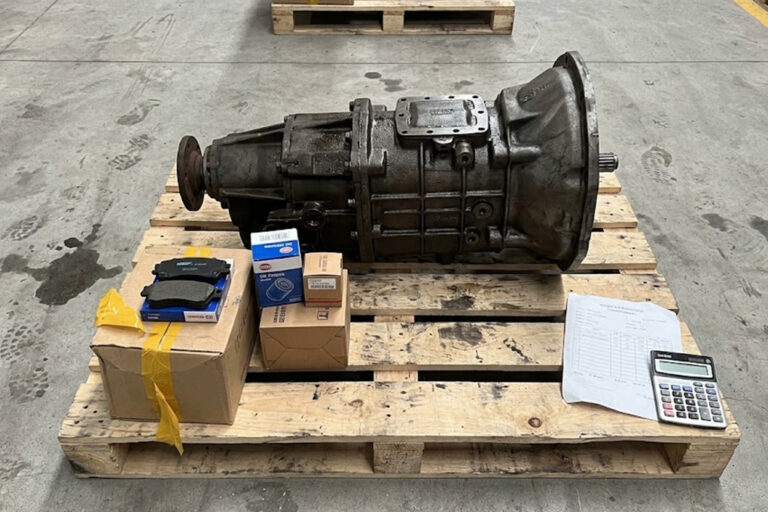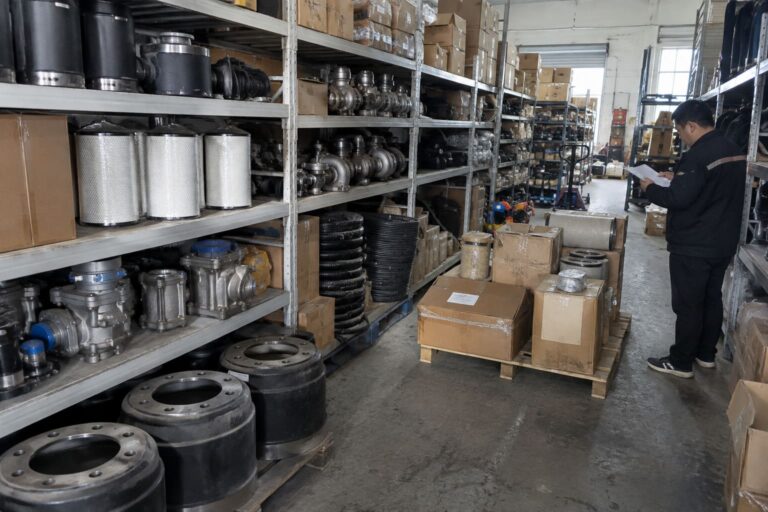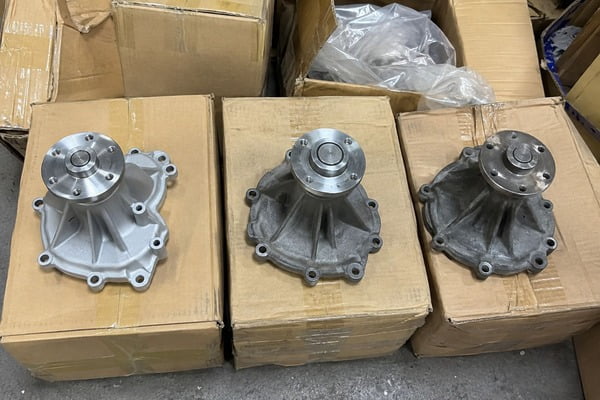
What Are the Most Common Truck Parts?
Sourcing replacement truck parts sounds straightforward until you realise that "common parts" means something different to every buyer. New importers often send us a truck brand name and expect a quote, but without model details, engine codes, or OE numbers, even the most frequently ordered categories can generate costly mismatches. This article explains how to think about the problem correctly.
The most common truck parts by inquiry volume are engine components (pistons, gaskets, water pumps, filters), brake system parts (chambers, pads, discs, wheel cylinders), suspension and steering components (shock absorbers, tie rods, leaf springs), transmission parts (clutch kits, gearbox bearings), and electrical and cabin parts (starters, alternators, lights, mirrors). However, knowing the category is only the starting point — the right question is always: which exact variant, matched to which truck model and OE number?
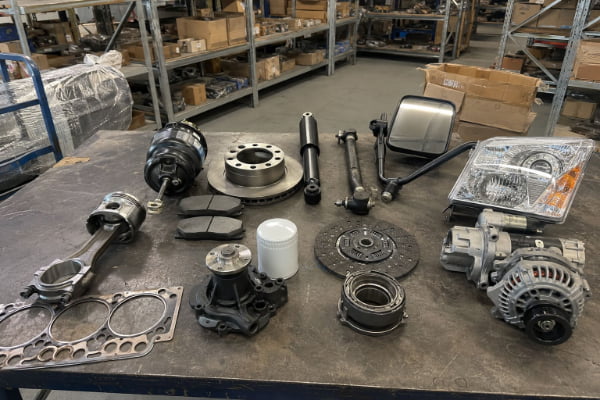
Understanding what parts buyers order most frequently is useful context. What is far more useful is understanding why those categories carry such high matching complexity — and what separates a sourcing process that goes smoothly from one that results in a warehouse full of parts that almost fit. The sections below work through each major category with exactly that framing.
Are Engine Parts Really the Most Ordered Truck Parts?
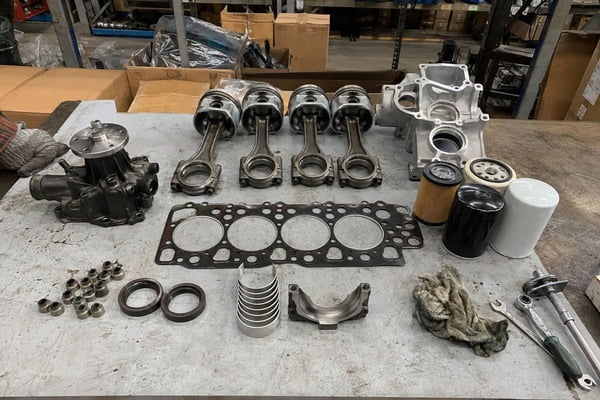
Engine-related inquiries make up a large share of the questions we receive every week. But buyers who treat "engine parts" as a single shopping category quickly run into trouble. Without a specific engine code and OE number, a piston listing is not a product — it is an ambiguous starting point.
Engine components are consistently among the highest-volume replacement parts across HOWO, SHACMAN, FAW, FOTON, and DONGFENG trucks, driven by regular maintenance cycles and wear-based replacement[1]. However, engine part numbers vary substantially even within the same truck brand — sometimes within the same production year — making OE number verification the mandatory first step in any sourcing inquiry.
Why "Engine Parts" Is a Decision Tree, Not a Category
When a buyer contacts us asking for engine parts for a HOWO truck, our first response is always a set of questions, not a quotation. The reason is straightforward: HOWO trucks have used multiple engine platforms over the years, including WD615, MC11, and D10 series engines from different manufacturers. A piston designed for a WD615 will not fit an MC11 block.
The information we typically need before confirming a match includes:
- Truck model and sub-variant (e.g., HOWO A7, not just HOWO)
- Engine code or displacement (stamped on the engine block or listed in the vehicle documentation)
- Production year or chassis number
- OE part number from the failed or worn component, where available
- Photos of the failed part, especially for worn or damaged items where the number plate is no longer legible
This is not excessive caution. It reflects the real complexity of the Chinese truck supply chain, where multiple engine manufacturers supply similar truck brands under different configurations.
The Highest-Turnover Engine Components
Across our regular customer base — primarily wholesalers, distributors, and maintenance fleets — the engine components with the highest replacement frequency include:
| Part | Replacement Driver |
|---|---|
| Engine oil filters | Scheduled maintenance |
| Air filters | Scheduled maintenance / environment |
| Fuel filters | Scheduled maintenance |
| Cylinder head gaskets | Heat fatigue, coolant leaks |
| Water pumps | Seal failure, bearing wear |
| Pistons and piston rings | High-mileage overhaul |
| Crankshaft bearings | Overhaul / oil starvation damage |
| Fan belts and tensioners | Wear, cracking |
Filters sit at the top of this list because they are time-based consumables. A fleet with 50 HOWO trucks running in a mining environment may replace air filters every two to four weeks[2]. For distributors supplying that segment, maintaining buffer stock of the correct filter references is a commercial priority, not an afterthought.
For higher-value components like pistons and head gaskets, the matching stakes are higher. These parts are application-specific, and incorrect fitment causes further damage. This is where experienced buyers send OE numbers first and wait for confirmation before placing volume orders.
Why Do Brake System Parts Carry the Highest Sourcing Risk?
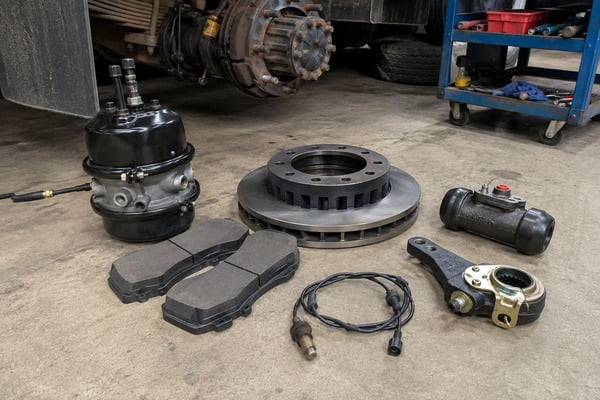
Brake parts are ordered frequently and failed brake components are rarely negotiable — a truck with a faulty brake chamber or worn disc pads cannot operate safely. But brake systems on Chinese commercial trucks carry more variant complexity than most buyers anticipate, and a mismatch here is not just a logistics problem.
Brake system parts — including brake chambers, slack adjusters, brake pads, discs, wheel cylinders, and ABS sensors — are among the most commonly replaced parts on heavy commercial trucks. They are also among the most safety-critical, meaning that sourcing errors have consequences beyond cost. Correct identification by truck model, axle configuration, and brake system type is non-negotiable.
Variant Differences That Buyers Frequently Underestimate
In our experience, brake system mismatches are one of the most common sourcing problems we help customers correct after they have already placed an order with a less-rigorous supplier. The scenarios that create the most problems include:
- Confusing HOWO A7 and T7H brake chambers. These are visually similar but dimensionally different. The T7H uses a larger brake chamber in some axle configurations. Buyers sourcing by truck brand alone — without specifying the sub-model — frequently receive the wrong part.
- Mixing drum and disc brake specifications. Newer HOWO and SHACMAN models increasingly use disc brakes at the front axle[3]. Buyers accustomed to drum-brake configurations for older models may not flag this when placing a replenishment order.
- Axle manufacturer differences. HOWO trucks use axles from different suppliers (Steyr-derived and SINOTRUK-developed axles have different brake component dimensions). The truck model name does not always tell you which axle is fitted.
What to Verify Before Sourcing Brake Parts
For brake system components, the matching information we ask for includes:
- Full truck model and year of manufacture
- Axle type and position (front steer axle, rear drive axle, trailer axle)
- Brake system type (drum or disc)
- OE number from the part being replaced — this is the most reliable confirmation method
- Photo of the old part, including any stamped markings
Buyers who supply all five data points get a confirmed match. Buyers who supply only the truck brand name get a request for clarification. This is not a process Caanass invented — it is the standard that any technically competent truck parts supplier should apply.
What Suspension and Steering Parts Are Ordered Most Often?
Suspension and steering wear is a function of load, road quality, and mileage — which means that fleets operating in rough-road environments (construction, mining, agriculture) replace these parts far more frequently than highway fleets[4]. Distributors serving those sectors often carry significant buffer stock.
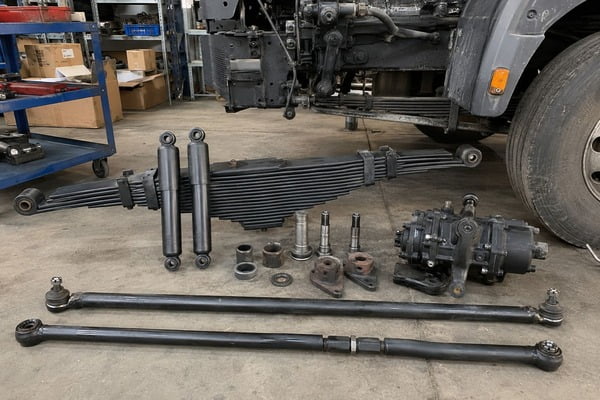
Suspension and steering parts — including leaf springs, shock absorbers, tie rods, drag links, king pins, and steering gear boxes — represent a high-volume replacement category for Chinese trucks. Wear rates accelerate in off-road and heavy-load environments, making accurate stock management important for distributors serving those markets.
The Parts That Move Fastest in Rough-Road Markets
Based on the inquiries we handle from customers in Africa, the Middle East, and Southeast Asia — regions where Chinese trucks operate under demanding conditions — the suspension and steering parts with the highest replacement velocity are:
- Leaf spring assemblies and individual spring leaves — fatigue cracking under heavy loads
- Shock absorbers — performance degradation and seal failure on rough roads
- King pin and bushing kits — steer axle wear, especially on high-mileage vehicles
- Tie rod ends and drag links — steering looseness, common in older vehicles
- Stabiliser bar bushings and links — rubber degradation and fatigue
Understanding Spring Leaf Specifications
Leaf springs are a category where buyers frequently underestimate specification complexity. The relevant dimensions include leaf width, leaf thickness, the number of leaves in the pack, the spring length, the eye diameter, and the load rating. Two springs that look similar can have entirely different load ratings and curvature profiles.
For distributors stocking springs, we recommend building a reference list that maps truck model and production year to confirmed spring OE numbers. This avoids repeated identification work on every order and reduces the risk of stocking incompatible variants.
How Should Buyers Think About Quality Tiers in Chinese Truck Parts?
This question comes up in almost every first conversation with a new overseas buyer. The honest answer is that Chinese truck parts are not a homogeneous category. Quality variation exists, and buyers who treat all Chinese-sourced parts as equivalent are making a risk management error.
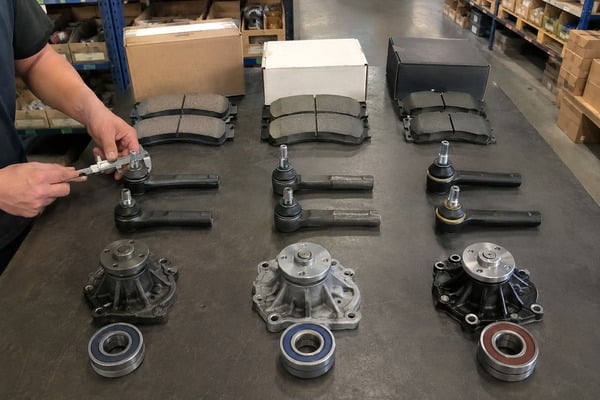
Not all Chinese replacement truck parts are equivalent in quality. The Chinese supply chain includes multiple manufacturing tiers — from parts produced by or for OEM suppliers, through mid-tier branded aftermarket manufacturers, to lower-cost generic producers. The right tier for a buyer depends on the application, the end customer's expectations, and the price point the market will support.
What Quality Variation Actually Looks Like
The differences across quality tiers are not always visible at the point of receipt. They tend to show up in:
- Material composition — lower-tier brake pads, for example, may use friction material with different thermal behaviour under heavy braking
- Dimensional tolerance — a pump or bearing with slightly looser tolerances may fit but fail sooner
- Surface treatment — cheaper suspension components may use thinner zinc plating, accelerating corrosion in humid or coastal environments[5]
- Heat treatment — relevant for gears, shafts, and bearings; harder to assess visually
We do not describe every product we supply as OEM or genuine unless we can confirm the specific supply relationship for that item. Buyers should treat any supplier claiming universal OEM status across thousands of SKUs with scepticism. The more defensible claim — and the one we can support — is accurate part matching, appropriate tier selection for the buyer's application, and transparent communication about what we know and what we cannot confirm.
Practical Guidance for Tier Selection
| Application | Recommended Approach |
|---|---|
| Fleet maintenance, volume replacement | Matched mid-tier branded parts; prioritise fit and availability |
| Safety-critical components (brakes, steering) | Request more detailed sourcing information; verify certifications independently |
| High-mileage overhaul | Discuss part history and specification with supplier before ordering |
| One-time urgent replacement | Prioritise speed and fit; document part used for future reference |
Frequently Asked Questions
What information should I send when requesting a truck parts quotation?
Send the full truck model and sub-variant, production year, and the OE part number if available. A photo of the worn or failed part is also helpful, especially when the number is no longer legible. The more specific the information, the faster and more accurately a supplier can confirm fitment and provide a reliable quotation.
Can I source parts for multiple Chinese truck brands from one supplier?
Yes, and consolidating across brands is a practical advantage for distributors. Caanass supplies replacement parts for HOWO, SHACMAN, FAW, FOTON, and DONGFENG trucks, which allows customers to combine brands into a single container order. This reduces freight cost per unit and simplifies supplier management for buyers handling multiple truck fleets.
Are Chinese replacement truck parts compatible with original specifications?
Compatibility depends on the specific part and supplier. Quality and specification consistency vary across the Chinese aftermarket supply chain. For critical components, buyers should request documentation, verify OE number matches, and consider having parts assessed by a qualified technician before committing to a volume order. We do not claim OEM status for every item we supply.
Why do brake parts have more fitment variants than other categories?
Brake systems are sensitive to axle manufacturer, brake type (drum versus disc), and vehicle configuration differences that are not always obvious from the truck model name alone. Variants within a single truck brand — such as HOWO A7 versus T7H — can use incompatible brake chambers. OE number verification is the only reliable way to confirm the correct variant.
How do experienced buyers reduce sourcing errors?
Experienced buyers maintain an internal parts reference list that maps truck model and year to confirmed OE numbers for the parts they order most frequently. They send OE numbers with every inquiry rather than relying on verbal descriptions or brand names alone. This single habit eliminates most fitment ambiguity and speeds up the quotation process significantly.
Conclusion
The most common truck parts — engine components, brake system parts, suspension and steering assemblies, transmission components, and electrical parts — are common in name but highly specific in application. The same part category can represent dozens of incompatible SKUs across HOWO, SHACMAN, FAW, FOTON, and DONGFENG trucks. Understanding what parts exist is only the beginning. Understanding how to match them correctly is where sourcing reliability actually comes from. If you are evaluating Chinese truck parts suppliers, the quality of the matching process — the questions a supplier asks before quoting — is a better indicator of reliability than any general product claim. If you are sourcing replacement parts for Chinese commercial trucks and want to work with a supplier that asks the right questions first, contact Caanass to discuss your parts requirements.
- [1]"Automotive aftermarket", https://en.wikipedia.org/wiki/Automotive_aftermarket. Market analyses of the commercial vehicle aftermarket consistently identify engine components — including filters, gaskets, and wear parts — as among the highest-volume replacement categories, driven by mandatory maintenance intervals and the cumulative effect of engine wear across large operating fleets. Evidence role: statistic; source type: institution. Supports: That engine-related components represent a leading category by volume in the heavy commercial vehicle aftermarket parts market. Scope note: Publicly available market data on Chinese truck aftermarket parts by category is limited; figures from general commercial vehicle aftermarket studies may not directly reflect the specific brand mix discussed in the article. ↩
- [2]"What is the recommended mileage for replacing air filters ...", https://www.facebook.com/groups/355057138660357/posts/1784600989039291/. Research on heavy vehicle maintenance in high-dust environments indicates that air filter service life is substantially reduced compared to highway conditions, with some fleet studies reporting intervals measured in weeks rather than months. Evidence role: general_support; source type: research. Supports: That air filter replacement intervals for heavy vehicles are significantly shortened in high-particulate environments such as mining operations. Scope note: Specific interval figures vary widely by filter type, engine displacement, and dust concentration; the two-to-four-week figure cited in the article should be treated as illustrative rather than universally applicable. ↩
- [3]"Shacman Howo:The Ultimate 2026 Comparison Guide", https://shacman3000.com/shacman-howo.html. Technical specifications published for recent HOWO and SHACMAN model generations indicate front axle disc brake configurations as standard or optional equipment, reflecting a broader industry trend toward disc brakes in heavy commercial vehicles. Evidence role: historical_context; source type: other. Supports: That Chinese heavy truck manufacturers have progressively adopted disc brake systems on front axles in newer model generations. Scope note: Publicly available manufacturer specification sheets may not comprehensively document all sub-variants, and the pace of adoption differs across model lines and export markets. ↩
- [4]"Automotive suspension component behaviors driven on flat and rough ...", https://pmc.ncbi.nlm.nih.gov/articles/PMC8287242/. Fleet maintenance research indicates that road surface quality and load conditions are primary determinants of suspension component service life, with vehicles operating in construction and mining environments exhibiting substantially higher wear rates and shorter replacement intervals than comparable vehicles in highway service. Evidence role: general_support; source type: research. Supports: That vehicle operating environment significantly affects suspension and steering component wear rates, with off-road and heavy-load applications producing higher replacement frequency than highway operation. Scope note: Quantitative comparisons between operating environments vary by study methodology, vehicle type, and specific component; direct data for Chinese truck models in these applications is limited in publicly available research. ↩
- [5]"Zinc Plating vs. E-Coating: Which Protects Better for Automotive Parts?", https://plateco.net/blog/zinc-plating-vs-e-coating-automotive-parts/. Corrosion science literature establishes that zinc electroplating thickness is a primary determinant of salt-spray and humidity resistance in steel automotive components, with standardized testing protocols demonstrating accelerated corrosion onset as coating thickness decreases below specified thresholds. Evidence role: mechanism; source type: paper. Supports: That zinc coating thickness on steel components is directly related to corrosion resistance, with thinner coatings providing reduced protection in high-humidity or salt-exposure environments. Scope note: General corrosion studies address coating performance broadly; specific data on zinc plating thickness variation across Chinese aftermarket suspension component tiers is not available in published academic sources. ↩