Truck Parts Manufacturers in China: Which Type of Supplier Actually Fits Your Business?
Finding the right truck parts manufacturers in China sounds straightforward — until you realize the word "manufacturer" covers everything from a 500-person OEM factory to a one-room trading company with a product catalog and a Alibaba storefront. International buyers across Africa, Southeast Asia, the Middle East, and South America[1] come to us with the same frustration: they searched, they contacted suppliers, and they still aren't sure who they're actually buying from.
The real challenge when sourcing truck parts manufacturers in China is not finding suppliers — it is identifying which type of supplier matches your operational model, order profile, and risk tolerance. For most international B2B buyers purchasing HOWO, SHACMAN, FAW, FOTON, or DONGFENG truck parts, the right question is not "who makes it?" but "who can reliably get me the correct parts, at the volume I need, without breaking my supply continuity?"
The answer depends heavily on how you buy, what you buy, and how many truck brands you're stocking. The sections below break down the real structure of the Chinese truck parts supply chain, the failure modes buyers most commonly hit, and how to evaluate whether a supplier can actually serve your business.
Does It Matter Whether Your Supplier Is a Manufacturer or a Trading Company?
Buyers regularly ask us to confirm whether we are a "direct manufacturer." The underlying assumption is that manufacturers are better — cheaper, more reliable, more authoritative. In practice, the answer is more complicated than that.
For most international buyers sourcing truck parts across multiple brands and part categories, the supplier type that matters is the one that can accurately match your OE numbers, consolidate mixed orders, and maintain consistent availability across a wide product range. A direct OEM factory specializing in one part category for one truck brand is rarely the answer to a full-container order covering fifty different SKUs[2].
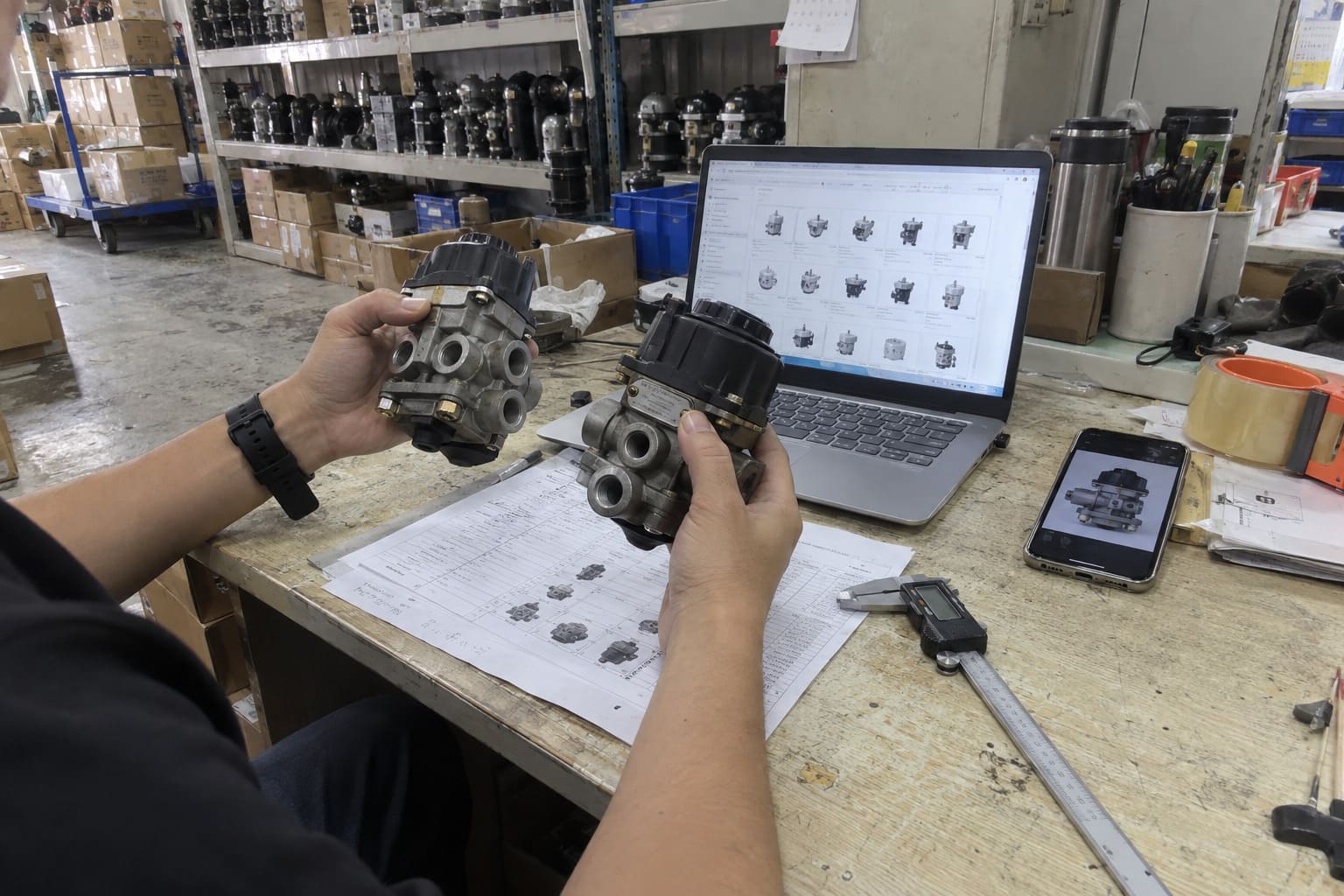
The Three Functional Supplier Types in the Chinese Truck Parts Market
Understanding who you're actually dealing with starts with knowing how the supply chain is structured. Based on the inquiries we handle from buyers in Africa, Southeast Asia, and the Middle East, most China-based sellers fall into one of three categories:
1. Direct OEM or OES Manufacturers
These are factories that produce specific part categories — engine components, brake assemblies, filters, electrical parts — for one or a few truck brands. They typically hold tooling, run production lines, and may supply directly to the truck assembler or to authorized aftermarket channels.
- Strengths: Competitive unit pricing at volume, deeper technical knowledge of their specific product, potential for customization or OEM/ODM packaging.
- Limitations: Narrow product scope. A brake drum manufacturer is not the right source for gearbox seals or cabin hardware. MOQs can be high. They often have limited export infrastructure and may not support mixed-container orders.
- Practical fit: Large fleets or distributors ordering high volumes of a single part category with a stable, recurring demand profile.
2. Trading Companies
Trading companies hold no production capacity of their own. They source from multiple manufacturers, maintain catalogs, and handle export documentation. Quality and sourcing consistency varies widely. Some are well-organized with stable supplier networks; others are essentially brokers with thin operational depth.
- Strengths: Broad product coverage, flexible order sizes, faster response for spot purchasing.
- Limitations: Accountability for quality is indirect. Parts compatibility claims may not be verified against OE data. Supply continuity depends on their upstream supplier relationships.
- Practical fit: Buyers placing diverse, smaller orders who understand the limitations and have their own quality inspection in place.
3. Hybrid Sourcing Companies (Warehouse + Manufacturer Relationships)
This is the model Caanass operates under. A hybrid supplier maintains physical inventory, holds established relationships with verified manufacturers across multiple brands and categories, and handles export, logistics, and parts matching internally. They function as a sourcing partner rather than a simple seller.
- Strengths: One-stop sourcing across brands (HOWO, SHACMAN, FAW, FOTON, DONGFENG), OE number-based compatibility verification, mixed-container support, recurring replenishment capability, and export coordination under one relationship.
- Limitations: Not the lowest-cost option for single-SKU bulk orders where a direct manufacturer relationship is available and stable.
- Practical fit: Regional distributors managing broad inventories, fleet operators with diverse truck fleets, and parts retailers with recurring replenishment needs across multiple categories.
| Supplier Type | Product Scope | Mixed Orders | OE Matching | MOQ Flexibility | Export Support |
|---|---|---|---|---|---|
| Direct OEM Manufacturer | Narrow | Limited | Specialist level | Often high | Variable |
| Trading Company | Broad | Yes | Variable | Flexible | Usually yes |
| Hybrid Sourcing Company | Broad | Yes | Systematic | Flexible | Yes |
The table above is a framework, not a guarantee. Individual suppliers vary. The categories help you ask better questions during evaluation.
How Do You Know If a Chinese Supplier Can Actually Identify the Right Parts?
This is the question we see most often from distributors in East Africa and fleet operators in Southeast Asia. They've received wrong parts before. The shipment arrived, the parts didn't fit, and the truck stayed off the road.
Parts misidentification is the most common and most costly sourcing failure in the Chinese truck parts market[3]. It is not primarily a manufacturing quality issue — it is a compatibility verification issue. A supplier who cannot confirm fitment by OE number, chassis number, or vehicle model before confirming your order is a risk regardless of their certifications.
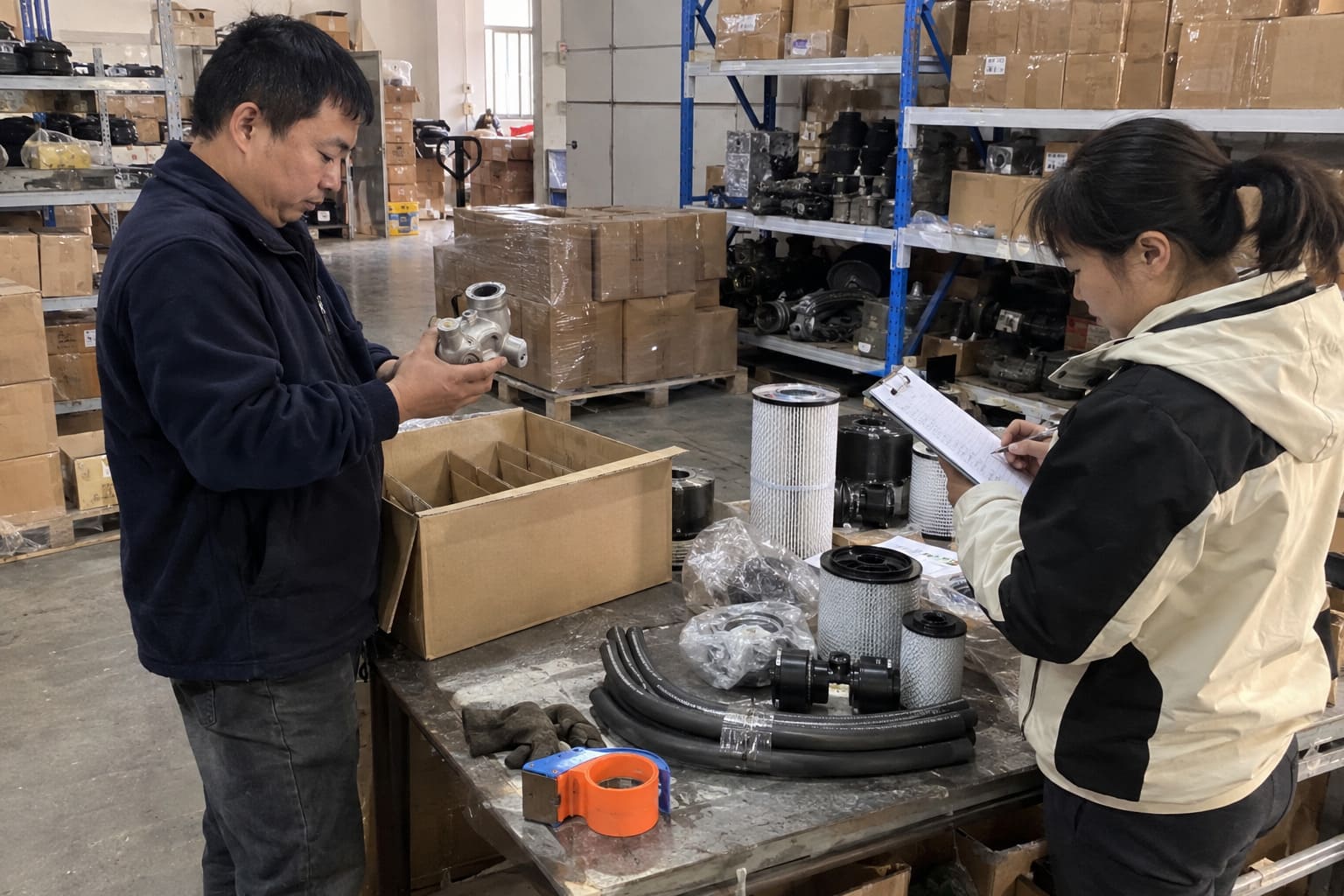
What Good Parts Identification Actually Looks Like
In our sourcing experience, buyers who have the fewest wrong-parts problems do two things consistently:
-
They supply OE numbers, not just part descriptions. "Front brake pad for HOWO" can match dozens of variants across different axle configurations, production years, and brake system generations. An OE number (e.g., WG9100443010) narrows it to one specific fitment.
-
They work with suppliers who verify before confirming. A supplier worth trusting will cross-reference your OE number against their catalog, flag discrepancies, and — in cases of uncertainty — ask for additional vehicle information (chassis number, production year, configuration details) before issuing a quotation.
Red Flags in Parts Identification
Watch for these patterns when evaluating a new supplier:
- Immediate confirmation without OE verification. If a supplier confirms availability for a complex part within minutes of a vague inquiry, they may be confirming catalog existence, not actual fitment compatibility.
- Generic descriptions in quotations. A quotation that reads "HOWO brake pad" without an OE number, part number, or specification is not a verified match — it is a placeholder.
- No follow-up questions. Legitimate sourcing requires information exchange. A supplier who never asks for clarifying details is not doing compatibility work.
- Inability to match across brands. If your fleet includes both SHACMAN and DONGFENG trucks, a supplier who only knows one brand creates sourcing fragmentation and additional risk.
The OE Number as the Primary Evaluation Criterion
We recommend treating OE number matching capability as your first supplier filter — before price, before certifications, before logistics terms. Ask a prospective supplier to confirm a specific part by OE number for a truck model you know well. Evaluate whether their response demonstrates actual catalog knowledge or generic placeholder behavior.
What Should International Buyers Prioritize When Evaluating Chinese Truck Parts Suppliers?
Buyers from markets like Saudi Arabia, Vietnam, Kenya, or Brazil often come to us after a sourcing failure with another supplier. The failure was usually one of three types: wrong parts, delayed supply, or a supplier who disappeared after the first order. Each of these maps to a specific evaluation criterion.
Price is rarely the root cause of sourcing failure. Wrong parts, supply discontinuity, and poor communication account for the majority of problems buyers describe to us[4]. Evaluating suppliers against these failure modes — rather than against price alone — produces better sourcing outcomes.
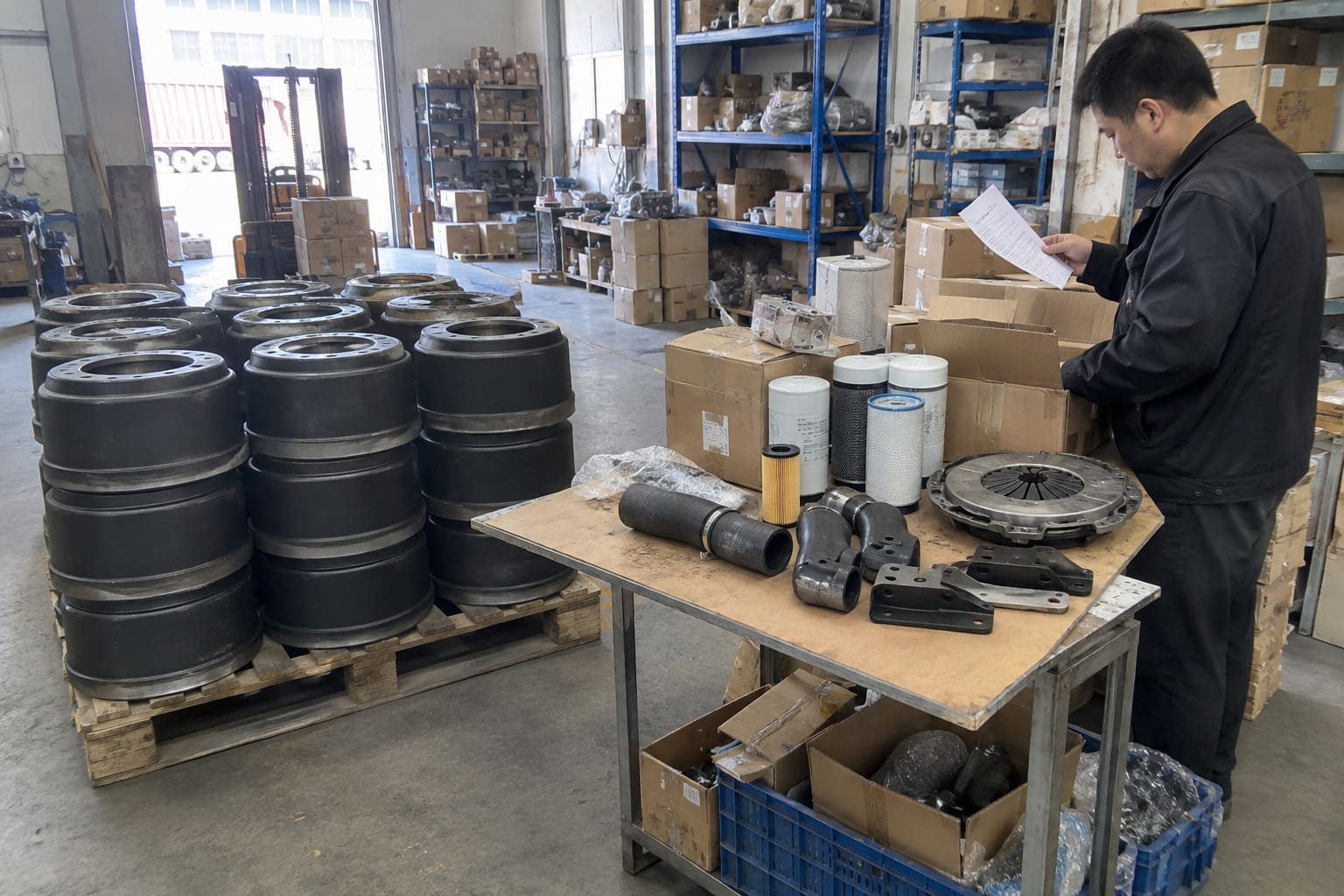
Supplier Evaluation Framework for International Buyers
1. Parts Scope and Brand Coverage
Can the supplier cover all the truck brands in your fleet or inventory? A supplier that covers HOWO but cannot source for FOTON or FAW forces you to maintain multiple supplier relationships — which multiplies communication overhead, logistics complexity, and quality variability.
Key questions:
- Which truck brands do you specialize in?
- How many active SKUs do you carry across those brands?
- Can you provide parts across system categories (engine, brake, transmission, suspension, electrical, cabin)?
2. Order Structure Compatibility
Your order pattern matters as much as the product range. Consider these scenarios:
- Full-container bulk orders: Can the supplier consolidate orders across categories and brands into a single container? This reduces per-unit logistics cost and simplifies customs documentation.
- Mixed-product orders: If you need 200 different SKUs in one shipment, does the supplier have the warehouse and coordination capacity to pick, pack, and export that order reliably?
- Recurring replenishment: Can the supplier maintain consistent availability for your fast-moving SKUs across multiple order cycles, or are they dependent on spot-sourcing each time?
3. Communication and Response Quality
In our experience, communication quality is a leading indicator of operational reliability. A supplier who responds promptly, asks clarifying questions, provides structured quotations with OE numbers and specifications, and flags uncertainty is more likely to execute orders correctly than one who responds vaguely or over-promises.
Test communication quality before placing a first order:
- Send a multi-item inquiry with OE numbers and see whether the response addresses each item specifically.
- Ask a clarifying question and evaluate the depth and accuracy of the answer.
- Request a sample quotation format to assess whether their documentation is export-ready.
4. Export and Logistics Capability
For international buyers, supplier value includes export readiness. Consider:
- Does the supplier handle export documentation, customs declarations, and freight coordination?
- Can they support different shipping terms (FOB, CIF, EXW) based on your preference?
- Do they have experience shipping to your specific market — including any import regulations or documentation requirements particular to your country?
5. Certifications as One Input, Not the Primary Filter
ISO certifications, product quality certificates, and test reports are worth requesting and verifying. However, they should be treated as supporting evidence, not primary qualification. A supplier with an ISO certificate and no OE matching capability is a greater sourcing risk than a well-organized hybrid supplier with documented order history and a verified parts catalog.
Ask for certifications. Then ask for an OE-matched quotation on a part you know. The second test tells you more.
Frequently Asked Questions
Is it better to buy truck parts directly from a Chinese manufacturer or through a trading company?
Neither is universally better. Direct manufacturers offer competitive pricing on high-volume single-SKU orders but typically have narrow product scope and high MOQs. Trading companies and hybrid sourcing companies offer broader coverage and mixed-order flexibility. For most international buyers managing diverse inventories across multiple truck brands, a structured sourcing partner is more practical than a direct manufacturer relationship.
How do I verify that a Chinese supplier's truck parts are compatible with my vehicles?
Provide the supplier with your OE numbers, truck model, chassis number, and production year. A reliable supplier will cross-reference this information against their catalog and confirm compatibility before issuing a quotation. Avoid suppliers who confirm orders without requesting this information — they are not doing compatibility verification.
What truck brands do Chinese parts suppliers typically cover?
The main Chinese truck brands with established aftermarket parts ecosystems are HOWO (Sinotruk), SHACMAN, FAW, FOTON, and DONGFENG[5]. A well-structured sourcing partner should be able to cover all five. Suppliers specializing in only one brand may not be suitable for fleets or distributors managing mixed-brand inventories.
Can I order mixed truck parts in a single container from a Chinese supplier?
Yes, but not all suppliers have the warehouse capacity and logistics coordination to execute mixed-container orders reliably. Confirm that your supplier can consolidate diverse SKUs across brands and categories into a single shipment, and ask about their packing and documentation process for mixed orders before committing.
What documentation should I request before placing a first order with a Chinese truck parts supplier?
At minimum, request a structured quotation with OE numbers and part specifications, a packing list format, and export documentation examples. You may also request product certificates, test reports, or quality certificates for specific parts. Verify that the supplier can issue the export documents your customs authority requires.
Conclusion
Sourcing truck parts manufacturers in China is ultimately a supplier-fit decision, not a catalog search. The most important filter is not whether a supplier calls itself a manufacturer — it is whether they can accurately identify parts by OE number, cover the truck brands in your fleet, support your order volume and structure, and maintain supply continuity across multiple order cycles. For most international distributors, fleet operators, and parts retailers, a hybrid sourcing partner with broad brand coverage and systematic parts matching capability will outperform a narrow direct-manufacturer relationship.
At Caanass, we specialize in sourcing parts for HOWO, SHACMAN, FAW, FOTON, and DONGFENG trucks — matching your OE numbers, consolidating mixed-container orders, and supporting recurring replenishment for international buyers across Africa, Southeast Asia, the Middle East, and South America. If you're evaluating suppliers or have a specific parts inquiry, contact us directly.
Email: grand@caanass.com WhatsApp: +86 19924698529
- [1]"China - Automotive Industry - export.gov", https://legacy.export.gov/article?id=China-Automotive-Components-Market. Chinese customs and industry association data indicate that developing economies in Africa, Southeast Asia, the Middle East, and Latin America collectively account for a substantial share of China's automotive parts export volume. Evidence role: statistic; source type: government. Supports: Developing regions including Africa, Southeast Asia, the Middle East, and South America represent significant export destinations for Chinese automotive and truck parts.. Scope note: Publicly available trade statistics typically aggregate automotive parts broadly and may not isolate heavy truck components as a distinct category. ↩
- [2]"How to Import Auto Parts from China – the Must-Know Guide", https://syzrodends.com/how-to-import-auto-parts-from-china-the-must-know-guide/. Research on Chinese automotive parts manufacturing structure indicates that OEM factories tend to concentrate production in specific component categories, with minimum order requirements and limited export infrastructure that constrain their utility for buyers seeking broad product consolidation. Evidence role: general_support; source type: research. Supports: Chinese OEM automotive parts manufacturers typically specialize in narrow product categories and impose minimum order quantities that limit their suitability for buyers requiring diverse, mixed-SKU shipments.. Scope note: Systematic quantitative data on MOQ norms across Chinese truck parts manufacturers is not widely published; this characterization is largely supported by industry observation rather than controlled study. ↩
- [3]"The U.S. Automotive Industry Supply Chain", https://www.boisestate.edu/cobe/blog/2025/02/the-u-s-automotive-industry-supply-chain-challenges-and-transformations/. Studies on automotive aftermarket supply chain quality identify parts misidentification and incorrect fitment as significant contributors to buyer losses, including vehicle downtime costs and return logistics expenses. Evidence role: general_support; source type: research. Supports: Parts misidentification and fitment errors are a recognized and costly failure mode in automotive aftermarket supply chains, contributing to vehicle downtime and financial loss.. Scope note: Available research addresses the broader automotive aftermarket; direct evidence specific to Chinese heavy truck parts exports and international B2B buyers is limited. ↩
- [4]"The U.S. Automotive Industry Supply Chain", https://www.boisestate.edu/cobe/blog/2025/02/the-u-s-automotive-industry-supply-chain-challenges-and-transformations/. Research on international B2B procurement outcomes identifies product quality failures, supply continuity disruptions, and communication deficiencies as the leading causes of sourcing dissatisfaction, with price competitiveness ranking lower as a root cause of supplier relationship failure. Evidence role: general_support; source type: research. Supports: In international B2B procurement, sourcing failures are more frequently attributed to quality and compatibility errors, supply disruptions, and communication breakdowns than to price-related factors.. Scope note: Available research addresses international procurement broadly; studies focused specifically on Chinese automotive or truck parts buyers are limited, and findings may not directly reflect this market segment. ↩
- [5]"Inside China's Truck Spare Parts Market", https://www.youtube.com/watch?v=ThUuGrBsz8A. Industry analyses of Chinese heavy truck exports indicate that Sinotruk, SHACMAN, FAW, FOTON, and DONGFENG account for the majority of Chinese heavy truck units in service internationally, providing the installed base necessary to sustain organized aftermarket parts ecosystems. Evidence role: general_support; source type: institution. Supports: Sinotruk (HOWO), SHACMAN, FAW, FOTON, and DONGFENG have the largest installed bases of heavy trucks in international markets, which supports the development of aftermarket parts supply networks for these brands.. Scope note: The depth of aftermarket infrastructure varies significantly by export market and brand; no standardized cross-brand aftermarket maturity index is publicly available. ↩