Sourcing HOWO spare parts for Kenya sounds straightforward until a container arrives in Mombasa and half the clutch kits don't fit. The gap between "I need HOWO parts" and "I need parts for a specific HOWO sub-model, engine variant, and chassis number" is where most procurement failures begin. A disciplined checklist, applied before you ever request a quotation, eliminates the majority of returns, delays, and margin loss.
Kenyan importers of HOWO spare parts should build their procurement process around four pillars: precise vehicle identification (sub-model, chassis number, engine variant), OE-number verification for every line item, explicit quality-tier agreement with the supplier, and a realistic logistics timeline from Guangzhou to Mombasa. Frontloading accuracy at the specification stage is far more valuable than negotiating a lower unit price on the wrong part.
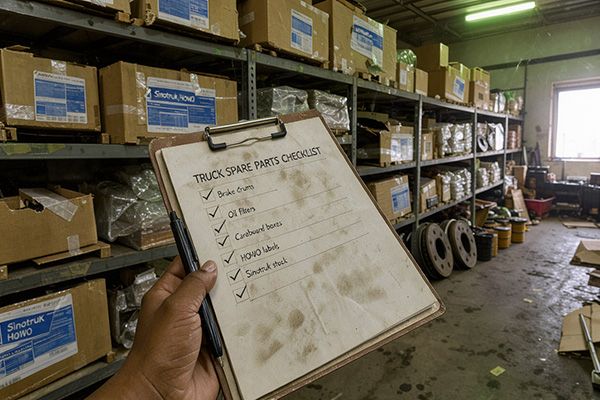
The sections below walk through each pillar in detail. I have organized them in the order you should address them during an actual purchasing cycle — starting with vehicle identification and ending with shipment planning. Whether you are a Nairobi-based wholesaler filling a container or a fleet manager restocking critical spares, this checklist will help you ask the right questions before money changes hands.
Why Does Sub-Model Confusion Cause So Many HOWO Parts Mismatches?
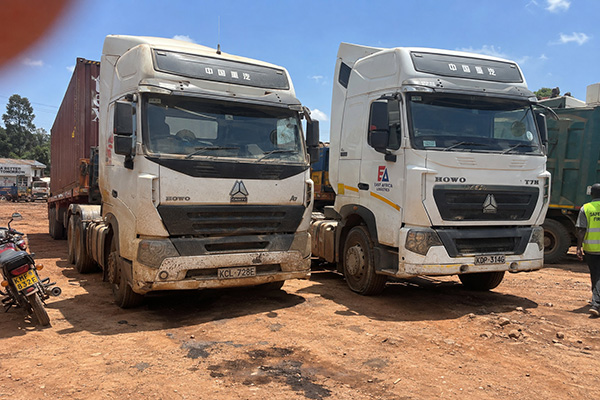
"HOWO" is one of the most recognized truck brands on Kenyan roads[1], yet buyers frequently treat it as a single vehicle platform. That assumption is the root cause of the most common procurement error I encounter: parts ordered for a generic "HOWO" that physically cannot fit the buyer's actual truck.
The reason is simple. HOWO is a brand family, not a single model[2]. The A7, T7H, N7, and older HOWO models share a badge but differ significantly in engine, transmission, cabin structure, and even frame dimensions. A clutch kit for an A7 with a WD615 engine is not the same clutch kit needed for a T7H running an MC11 engine[3]. Ordering "a HOWO clutch kit" without specifying the sub-model and engine variant is like ordering "a phone charger" without specifying the brand or port type.
How Sub-Model Differences Affect Parts Selection
In our experience handling Kenya-bound orders, we see the following divergence patterns across common HOWO variants:
| Component Area | HOWO A7 | HOWO T7H | HOWO N7 / Newer Models |
|---|---|---|---|
| Engine family | WD615 / WD618 | MC11 / MC13 | MC11 / D12 variants |
| Transmission | HW19710 / HW15710[4] | HW25712 (common) | Varies by spec |
| Cabin structure | Older-generation cabin | Redesigned cabin, different mounting | Further redesign |
| Electrical system | Older wiring harness | CAN-bus architecture[5] | Updated electronics |
| Brake system | Drum brake standard | Disc brake options available | Model-dependent |
This table is simplified — actual variation is even wider when you account for export-spec differences and running production changes Sinotruk has made over the years. The point is clear: the sub-model dictates which parts fit.
What Information Should You Collect Before Contacting a Supplier?
Here is the minimum identification data I recommend every buyer have ready:
- Sub-model designation — A7, T7H, N7, or the specific model code (e.g., ZZ4257V3247N1B)
- Chassis number (VIN) — This is the single most reliable identifier. It encodes the manufacturing year, engine type, and configuration.
- Engine model — Found on the engine nameplate, typically on the left or right side of the block. Examples: WD615.69, MC11.44-50, D12.42-20.
- Transmission model — Stamped on the transmission housing.
- Production year or approximate registration year — Helps narrow down running changes.
A common pattern we see in enquiries from Nairobi-based wholesalers is a parts list with "HOWO" written at the top and no further vehicle detail. When we ask for the chassis number, sometimes the response is "I'll check" — and that check saves the entire order from a mismatch. The checklist starts here: never request a quotation until you have at least the sub-model and chassis number confirmed.
Practical Tip: Where to Find the Chassis Number
On most HOWO trucks, the chassis number is stamped on a metal plate on the right side of the frame rail, near the front axle. It is also recorded on the vehicle registration document. If the plate is corroded or unreadable, the registration papers or the original purchase invoice are fallback sources. Some fleet operators photograph every truck's nameplate during intake — I strongly recommend this practice for any fleet with more than a few vehicles.
How Do OE Numbers Prevent Ordering Errors for HOWO Spare Parts?
Even after identifying the correct sub-model, buyers still face a second layer of risk: specifying the wrong part because they relied on a photo, a verbal description, or the phrase "same as last time." The OE (Original Equipment) number is the only universally reliable way to identify a specific HOWO spare part across different suppliers, warehouses, and countries.
An OE number — sometimes called a part number or reference number — is the alphanumeric code assigned by the manufacturer (Sinotruk, in this case) to identify a specific component. It accounts for dimensions, materials, revisions, and application. When you provide an OE number, any competent supplier can cross-reference it against their catalog and confirm whether they stock that exact item or a verified equivalent.
Why Photos and Descriptions Are Not Enough
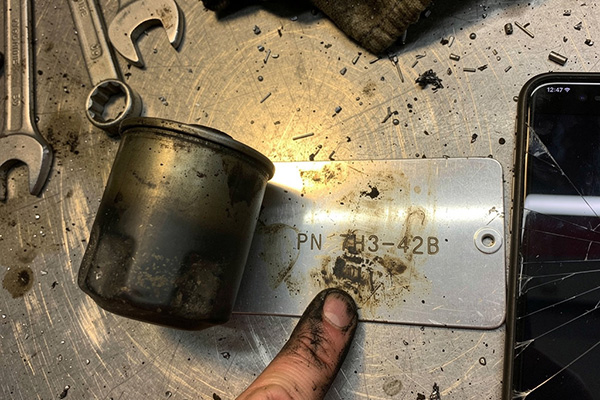
I have seen cases where a buyer sends a photo of a broken oil filter housing and says "I need this part." The photo shows the shape, but it does not tell me the mounting bolt pattern, the gasket specification, or whether the truck uses the updated version Sinotruk introduced midway through a production run. Production changes are common. Sinotruk, like all large manufacturers, periodically revises components — sometimes changing internal dimensions or materials without changing the external appearance[6]. The OE number captures these revisions. A photograph cannot.
Similarly, "same as last time" fails when a buyer's previous order was for a different customer's truck, or when the supplier's stock has rotated to a different batch. The OE number is the anchor that keeps everyone aligned.
How to Extract an OE Number
There are several reliable methods:
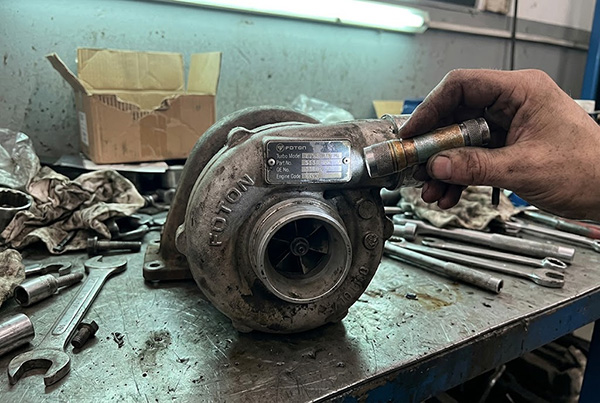
- Component nameplate or stamp: Many HOWO parts — especially engine components, filters, and brake parts — have the OE number stamped, printed, or labeled directly on the part. Check the old part before discarding it.
- Vehicle VIN decode: A supplier with access to Sinotruk's parts catalog system can decode the VIN and retrieve the correct OE numbers for that specific vehicle configuration.
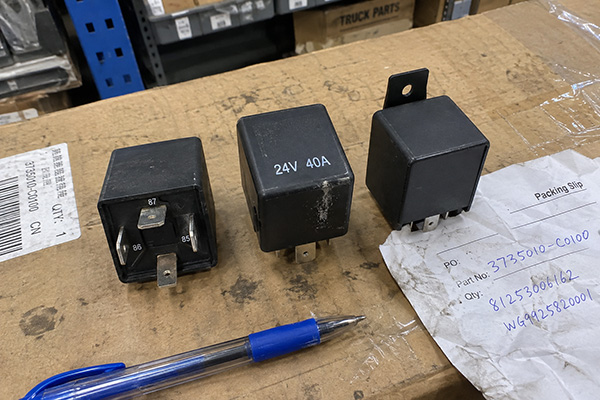
- Previous purchase invoice: If you ordered the same part before, the invoice or packing list from your supplier should include the OE number.
- Parts list from the truck's manual: HOWO trucks are typically delivered with a parts manual. If the fleet operator still has it, this is a primary source.
Building a Parts List the Right Way
When preparing a procurement list for HOWO spare parts for Kenya, I recommend structuring it as a table with at minimum these columns:
| Line | OE Number | Part Description | Sub-Model / Engine | Qty | Quality Tier Requested |
|---|---|---|---|---|---|
| 1 | WG9725160100 | Brake drum, rear | A7 / WD615 | 20 | OEM-grade |
| 2 | VG1246060094 | Oil filter element | T7H / MC11 | 50 | Genuine Sinotruk |
| 3 | WG9925720020 | Headlamp assembly, LH | A7 cabin | 10 | Aftermarket acceptable |
This format gives the supplier everything needed to quote accurately, cross-check compatibility, and flag any mismatches before production or picking begins. It also creates a documented reference for both parties — invaluable if a dispute arises later.
Why Does Quality-Tier Mismatch Silently Erode Your Margins?
Price comparison is the default tool Kenyan importers use to evaluate Chinese HOWO spare parts suppliers. But a lower quote does not always mean a better deal — it may simply mean a different quality tier. If you compare a genuine Sinotruk-branded part against an unbranded aftermarket alternative without realizing the difference, every conclusion you draw from that comparison is flawed.
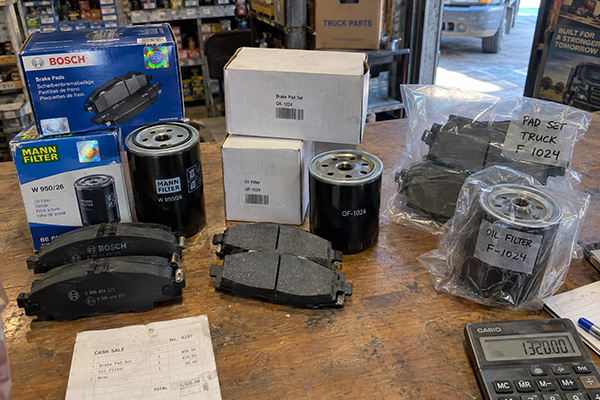
Quality-tier mismatch is one of the most underappreciated risks in HOWO parts procurement. Two suppliers may quote the same OE number at different prices because one is offering OEM-grade components and the other is offering economy aftermarket parts. Without explicit quality-tier confirmation on every line item, you cannot make a valid price comparison.
Understanding the Common Quality Tiers
In the Chinese truck-parts supply chain, products broadly fall into these categories:
| Quality Tier | Description | Typical Buyer Profile |
|---|---|---|
| Genuine (Original) | Manufactured by or for Sinotruk, carrying the Sinotruk / HOWO brand and packaging | Fleet operators prioritizing uptime, warranty compliance |
| OEM-grade | Made by the same or equivalent factory that supplies Sinotruk, but sold under a different brand or unbranded | Wholesalers seeking a balance between quality and cost |
| Aftermarket (branded) | Produced by independent manufacturers to match OE specifications, sold under their own brand | Distributors and retailers in price-sensitive markets |
| Economy aftermarket | Lower-cost alternatives, may use lighter materials or simplified designs | High-volume, low-margin retail environments |
None of these tiers is inherently "bad." Each serves a legitimate market need. The problem arises when a buyer thinks they are comparing OEM-grade against OEM-grade, but one supplier is actually quoting economy aftermarket. The price difference looks like a better deal. The reality is a different product.
How to Add a Quality-Tier Check to Your Procurement Process
I recommend three steps:
- State your quality-tier expectation explicitly on every RFQ (Request for Quotation). Use the table format shown earlier, with a "Quality Tier Requested" column.
- Ask the supplier to confirm the quality tier in their quotation. A reputable supplier should be willing to state clearly whether a quoted item is genuine, OEM-grade, or aftermarket.
- Request sample shipments for new suppliers or new product lines. Before committing to a full container, test a small quantity. Inspect markings, packaging, and finish quality. Compare against a known genuine part if possible.
The Hidden Cost of Getting This Wrong
When a Kenyan repair shop installs an economy-tier brake pad believing it to be OEM-grade, the pad may wear faster, leading to a shorter replacement cycle. The shop owner's cost-per-kilometer goes up, but they may attribute the issue to "bad Chinese parts" rather than to an incorrect quality-tier assumption at the procurement stage. This reputational damage flows back up the supply chain to the wholesaler and, ultimately, to the entire concept of sourcing from China.
The checklist item is simple: confirm quality tier in writing before you compare prices. This single step protects your margins, your customers' trust, and your long-term supplier relationships.
How Should You Plan Lead Times from Guangzhou to Mombasa?
First-time importers of HOWO spare parts for Kenya routinely underestimate the total time between placing an order and having parts available for sale or installation. This miscalculation disrupts restocking cycles, creates emergency shortages, and sometimes forces buyers into expensive airfreight or local-market purchases at premium prices.
A realistic procurement timeline from order confirmation to delivery in Kenya typically spans 35 to 50 days. This includes order processing and picking (3–7 days), container loading and departure from Guangzhou or nearby ports (3–5 days), sea freight to Mombasa (20–28 days)[7], and customs clearance plus local delivery (5–10 days). First-time importers should add a buffer of at least one week for unexpected delays.
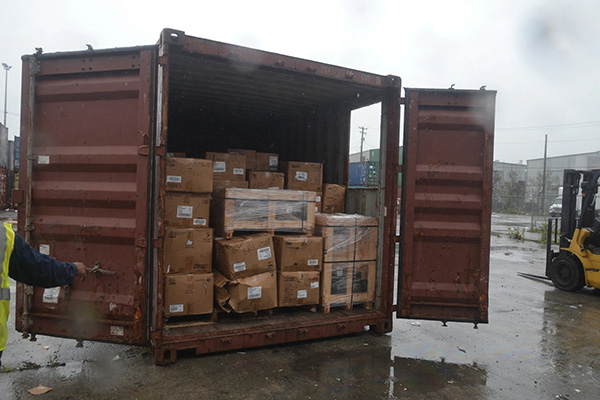
A Step-by-Step Timeline Template
Here is a reference timeline based on our experience with Kenya-bound shipments. Actual durations vary depending on shipping line schedules, port congestion, and customs processing speed.
| Stage | Typical Duration | Notes |
|---|---|---|
| Order confirmation & payment | 1–3 days | Depends on payment method and buyer's internal approval |
| Parts picking & quality check | 3–7 days | Longer for mixed orders across many categories |
| Container loading & port departure | 3–5 days | Guangzhou / Nansha port; schedule alignment matters |
| Sea freight to Mombasa | 20–28 days | Direct routes faster; transshipment adds days |
| Mombasa CFS & customs clearance | 5–10 days | Highly variable; clearing agent efficiency is key |
| Local transport to Nairobi or upcountry | 1–3 days | Nairobi is ~480 km from Mombasa by road |
| Total estimated range | 33–56 days | Plan for the longer end on first orders |
Factors That Extend Lead Times
Several common factors push timelines beyond the baseline:
- Mixed-container orders with many SKUs: A single-product container is fast to pick. A mixed container with 200 different HOWO parts across engine, brake, cabin, and electrical categories requires more picking, inspection, and packing time.
- Chinese public holidays: Chinese New Year (January/February), National Day (early October), and other holidays can add 1–3 weeks to processing times[8]. Plan major orders around these windows.
- Mombasa port congestion: Seasonal spikes in cargo volume or documentation backlogs at Kenya Revenue Authority can extend clearance times. Your clearing agent is your best source of real-time information here.
- Documentation errors: Incorrect packing lists, mismatched invoice values, or missing certificates can trigger customs holds. Double-check all export documents before shipment.
A Note on Kenyan Import Requirements
Buyers should be aware that Kenya has specific requirements for imported auto parts, including potential KEBS (Kenya Bureau of Standards) compliance[9] and applicable import duties. I strongly recommend verifying all current regulatory requirements, duty rates, and documentation needs directly with your licensed clearing agent or the Kenya Bureau of Standards. These requirements change periodically, and I am not in a position to provide definitive regulatory guidance from the supplier side. What I can do is ensure that packing lists, commercial invoices, and product descriptions on our end are accurate and consistent with your clearing agent's requirements.
Building a Restocking Calendar
For repeat importers, I recommend building a simple restocking calendar:
- Identify your fastest-moving HOWO parts — the 20% of SKUs that drive 80% of your sales volume[10].
- Calculate your sell-through rate for each fast mover — how many units you sell per month.
- Set a reorder trigger point that accounts for the full lead time plus a safety buffer. If you sell 100 brake drums per month and the full cycle takes 45 days, your reorder trigger should be at roughly 150 units remaining.
- Communicate your restocking schedule to your supplier in advance. This allows the supplier to pre-stage or reserve stock, reducing picking time on your next order.
What Should Your Final Pre-Order Checklist Look Like?
Bringing all four pillars together, here is a consolidated checklist you can use before submitting any HOWO spare parts order destined for Kenya:
- [ ] Sub-model confirmed for every vehicle the parts will serve (A7, T7H, N7, etc.)
- [ ] Chassis number (VIN) collected for each truck or model variant
- [ ] Engine model verified from nameplate or documentation
- [ ] OE number listed for every line item — no "same as photo" entries
- [ ] Quality tier specified per line item (genuine, OEM-grade, branded aftermarket, economy)
- [ ] Supplier has confirmed quality tier in their quotation
- [ ] Lead-time calculation completed using the timeline template above
- [ ] Restocking trigger points set for fast-moving items
- [ ] Clearing agent briefed on expected arrival window and documentation requirements
- [ ] Chinese holiday calendar checked for potential processing delays
This checklist is not bureaucratic overhead. Every item on it exists because I have seen the corresponding mistake cost a buyer real money — whether through returns, delays, customs holds, or margin erosion from quality-tier confusion.
Frequently Asked Questions
Can I use the same parts for a HOWO A7 and a HOWO T7H?
Some consumables like certain filters or standard fasteners may be shared, but most major components — engine parts, transmission parts, cabin parts, and brake system components — differ between the A7 and T7H. Always verify compatibility using the chassis number and OE number rather than assuming cross-model fitment.
How do I verify that a supplier is quoting the correct OE number?
Provide your chassis number or VIN alongside the OE number. A knowledgeable supplier can cross-reference the two and confirm whether the part matches your specific truck configuration. If a supplier cannot perform this verification, consider it a risk indicator.
What is the minimum order quantity for shipping HOWO parts to Kenya?
This varies by supplier. Many suppliers work with full-container loads (FCL) for cost efficiency, but mixed-container and less-than-container-load (LCL) options are available. For a first order, a mixed container covering your highest-demand SKUs is often a practical starting point that balances cost with product range.
Should I always choose genuine Sinotruk parts over aftermarket?
Not necessarily. The right quality tier depends on the application, the end customer's expectations, and the price sensitivity of your market. Genuine parts offer the closest match to original specifications. OEM-grade and quality aftermarket parts can deliver strong performance at a lower cost. The important thing is to know which tier you are buying and price accordingly.
How can I handle parts identification when the truck's nameplate is damaged or missing?
Use the vehicle registration document, the original purchase invoice, or any maintenance records that list previous part numbers. If those are unavailable, a clear photograph of the engine nameplate, transmission housing stamp, and overall truck exterior can help a supplier narrow down the configuration. The VIN from registration papers is usually the most reliable fallback.
Conclusion
Procuring HOWO spare parts for Kenya successfully is less about finding the cheapest price and more about eliminating specification errors before they enter your supply chain. The four-pillar checklist — sub-model identification, OE-number verification, quality-tier confirmation, and realistic lead-time planning — addresses the root causes of the most costly mistakes I see in Kenya-bound orders. Every step you invest in accuracy upfront saves multiples in avoided returns, delays, and customer dissatisfaction downstream.
If you are building or refining your HOWO parts sourcing process and want to discuss vehicle-to-part matching for your specific inventory needs, I welcome the conversation. Reach out to our team at grand@caanass.com or via WhatsApp: +86 19924698529 — we are glad to help you work through the identification details before any order commitment.
- [1]"The Kenyan Automotive Industry: Historical Trends and ...", https://www.usitc.gov/sites/default/files/publications/332/executive_briefings/ebot_kenya_automotive_sector.pdf. Sinotruk has been among the leading exporters of heavy commercial vehicles to African markets, with Kenya representing a significant destination; industry reports and trade data indicate substantial growth in Chinese truck imports to East Africa over the past decade, with HOWO models widely visible in freight and construction applications. Evidence role: general_support; source type: research. Supports: That Chinese-manufactured trucks, particularly Sinotruk HOWO models, have achieved significant market penetration in Kenya and East Africa. Scope note: Precise market share figures for HOWO in Kenya are not consistently published in publicly accessible English-language sources; claims of brand recognition are supported by trade volume trends rather than formal brand awareness surveys. ↩
- [2]"China National Heavy Duty Truck Group", https://en.wikipedia.org/wiki/China_National_Heavy_Duty_Truck_Group. Sinotruk's HOWO product family includes several distinct platforms—among them the A7, T7H, and N7—each designed around different powertrain and cabin configurations, as documented in Sinotruk's corporate product disclosures and industry references. Evidence role: general_support; source type: encyclopedia. Supports: That Sinotruk's HOWO brand encompasses multiple distinct truck platforms with different engines, transmissions, and cabin designs. Scope note: Corporate product pages may not detail all export-spec variations relevant to the Kenyan market. ↩
- [3]"HOWO vs SITRAK C7H/C9H (MAN MC11/MC13 Engines)", https://sinotruksgroup.com/sinotruk-guide-howo-vs-sitrak-c7h-c9h-man-mc11-mc13/. The WD615 is a Steyr-derived inline-six diesel engine of approximately 9.7 L displacement, while the MC11 is a newer-generation 10.5 L engine developed by Sinotruk with different bore, stroke, and accessory mounting interfaces, confirming fundamental component incompatibility between the two platforms. Evidence role: mechanism; source type: research. Supports: That the WD615 and MC11 are distinct engine families with different displacement, dimensions, and mounting configurations, requiring different mating components. Scope note: Detailed clutch-kit-specific incompatibility data may not be publicly documented outside OEM parts catalogs. ↩
- [4]"China National Heavy Duty Truck Group", https://en.wikipedia.org/wiki/China_National_Heavy_Duty_Truck_Group. The HW19710 is a 10-forward-speed manual transmission and the HW15710 a variant in Sinotruk's HW-series gearbox lineup, both widely documented in Sinotruk parts catalogs and technical specifications as standard or optional transmissions for the HOWO A7 platform. Evidence role: general_support; source type: other. Supports: That the HW19710 and HW15710 are transmission models used in Sinotruk HOWO A7 trucks. Scope note: Transmission availability varies by market, configuration, and production year; catalog data from Sinotruk may not reflect all export-specification variants shipped to Kenya. ↩
- [5]"CAN bus", https://en.wikipedia.org/wiki/CAN_bus. CAN-bus (Controller Area Network) technology, originally developed by Bosch in the 1980s and standardized under ISO 11898, has been widely adopted in modern heavy commercial vehicles for multiplexed communication between electronic control units, replacing conventional wiring harnesses and requiring model-specific electronic components. Evidence role: mechanism; source type: research. Supports: That modern Chinese heavy trucks, including newer Sinotruk HOWO models, have adopted CAN-bus (Controller Area Network) electrical architectures replacing conventional point-to-point wiring harnesses. Scope note: The specific generation at which Sinotruk transitioned to CAN-bus architecture across its HOWO lineup is not precisely documented in publicly available English-language sources. ↩
- [6]"Section 1105 | Revised 10/20/2026", https://ia.iowadot.gov/erl/current/GS/content/1105.htm. Engineering change orders (ECOs) are a standard practice in automotive manufacturing, allowing OEMs to update materials, tolerances, or internal geometry of components during ongoing production, often without visible external changes, as documented in automotive quality management literature. Evidence role: mechanism; source type: research. Supports: That automotive and heavy vehicle manufacturers routinely implement engineering change orders that revise component specifications during a production run without altering external form factor. Scope note: General automotive engineering literature supports the practice broadly; Sinotruk-specific ECO documentation is not publicly available. ↩
- [7]"Shipping cost calculation for the route from Guangzhou to ...", https://agorafreight.net/shipping-quotes/fcl-from-guangzhou-to-mombasa/. Major shipping lines operating the China–East Africa route report typical transit times of 20–30 days from Guangzhou/Nansha to Mombasa, with direct services at the shorter end and transshipment via intermediate ports (e.g., Colombo, Port Klang) adding several days. Evidence role: statistic; source type: other. Supports: That ocean freight transit from Guangzhou/Nansha to Mombasa typically takes approximately 20–28 days depending on routing and transshipment. Scope note: Transit times fluctuate based on carrier schedules, vessel availability, and seasonal demand; quoted ranges are indicative rather than guaranteed. ↩
- [8]"Chinese New Year and its Impact on Global Supply Chain", https://ctl.mit.edu/news/chinese-new-year-and-its-impact-global-supply-chain. The Chinese New Year (Spring Festival) holiday typically results in a factory shutdown period of 1–4 weeks, with pre- and post-holiday production slowdowns extending the effective disruption period; trade logistics research identifies this as the single largest recurring supply chain disruption for buyers sourcing from China. Evidence role: general_support; source type: research. Supports: That Chinese public holidays, especially the Chinese New Year/Spring Festival period, cause significant disruptions to manufacturing output and export logistics, often extending lead times by one to three weeks or more. Scope note: The exact duration of disruption varies by factory, industry, and year; the 1–3 week estimate is a general range rather than a fixed rule. ↩
- [9]"Kenya Pre-Verification of Conformity (PVOC) Program", https://www.trade.gov/market-intelligence/kenya-pre-verification-conformity-pvoc-program. The Kenya Bureau of Standards (KEBS) administers a Pre-Export Verification of Conformity (PVoC) program requiring that regulated imports, including automotive components, undergo conformity assessment before shipment to Kenya, as specified under Kenya's Standards Act and related import inspection regulations. Evidence role: general_support; source type: government. Supports: That Kenya requires imported goods, including automotive spare parts, to comply with Kenya Bureau of Standards regulations, typically through the Pre-Export Verification of Conformity (PVoC) program. Scope note: Specific product categories, applicable standards, and exemptions change periodically; importers should verify current requirements directly with KEBS or an authorized PVoC agent. ↩
- [10]"What is the 80/20 Inventory Rule?", https://www.netsuite.com/portal/resource/articles/inventory-management/80-20-inventory-rule.shtml. The Pareto principle, first observed by economist Vilfredo Pareto and later popularized in quality management by Joseph Juran, holds that roughly 80% of effects come from 20% of causes—a pattern widely applied in inventory management to identify high-turnover SKUs that warrant priority in procurement planning. Evidence role: definition; source type: encyclopedia. Supports: That the Pareto principle (80/20 rule) is a widely recognized distribution pattern in inventory management where a small proportion of SKUs typically accounts for the majority of sales volume. Scope note: The 80/20 ratio is an approximation; actual distributions in specific spare parts businesses may vary. ↩