Finding a reliable FAW truck parts catalog is one of the most common challenges international buyers face when sourcing components for FAW trucks. You search online, find scattered PDFs, incomplete lists, and outdated references — and still aren't sure you're looking at the right part for your specific truck. The real solution isn't finding a catalog. It's building a reliable identification-to-order workflow.
There is no single, universal FAW truck parts catalog that covers every model, year, and market variant. FAW produces multiple truck lines — J5, J6, JH6, CA series, and others[1] — each with distinct parts references that vary by chassis number, engine configuration, and export market. The most effective path to the correct part starts not with a catalog, but with your chassis number, OE part number, or a clear photograph of the component you need.
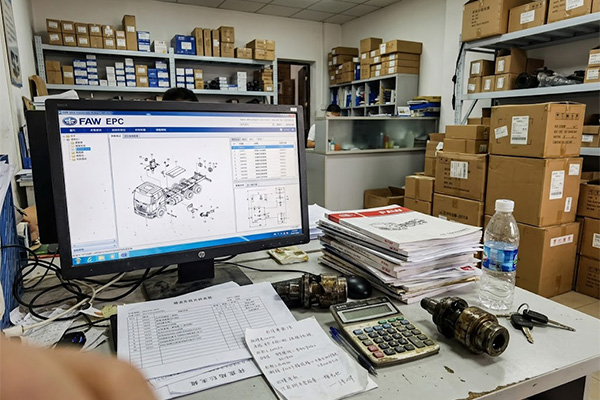
That answer might surprise you if you expected a single download link. But in our two decades of handling FAW parts inquiries, we've seen more ordering errors caused by trusting a generic catalog than by having no catalog at all. Below, I'll walk you through the practical reference paths available, the tradeoffs of each, and how to turn any starting point into a confirmed, correct part order.
Why Is There No Single Universal FAW Parts Catalog?
If you've been searching for "the" FAW catalog, you've probably noticed that results are fragmented, incomplete, or contradictory. This isn't a gap in your research — it reflects the actual complexity of FAW's product range.
FAW (First Automobile Works) manufactures a broad portfolio of heavy-duty, medium-duty, and light-duty trucks[2]. Parts references are not interchangeable across these lines. Even within a single model series, configurations differ by production year, engine variant, emission standard, and the specific market the truck was assembled or exported for[3]. A single catalog simply cannot represent this level of variation accurately[4], which is why experienced buyers treat any catalog as a starting reference — not a final answer.
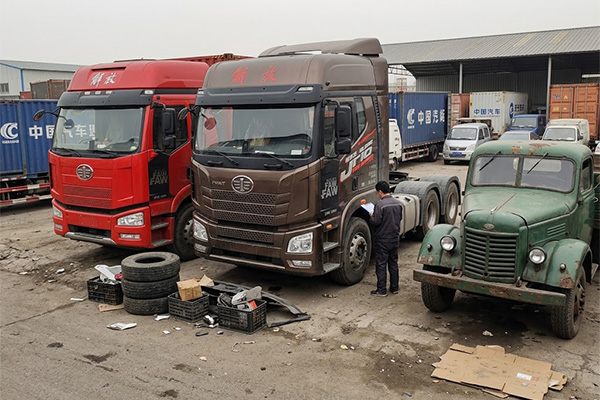
How Model and Chassis Variation Creates Catalog Fragmentation
To understand why one catalog can't cover everything, consider what varies across FAW trucks:
| Variable | Impact on Parts Reference |
|---|---|
| Truck series (J5, J6, JH6, CA3250, etc.) | Completely different parts structure and numbering |
| Production year | Design revisions change part numbers for the same component |
| Engine type (Xichai, Weichai, Cummins) | Engine-related parts differ entirely by powertrain |
| Emission standard (China III, IV, V, VI) | Fuel system, exhaust, and sensor parts vary |
| Export market | Some export variants use localized specifications |
| Chassis number | The definitive identifier tying a specific truck to its exact parts list |
In the inquiries we handle daily, buyers who start with "I need a brake drum for a FAW J6" often discover there are multiple brake drum specifications depending on the axle configuration and production batch. The chassis number resolves this ambiguity. A generic catalog listing typically does not.
What This Means for Your Procurement Process
This fragmentation doesn't mean catalogs are useless. It means they serve as navigation tools, not order confirmations. A catalog can help you identify the general part category, narrow down candidate OE numbers, and communicate more precisely with your supplier. But the final step — confirming the exact part number matches your truck — requires either chassis-level verification or supplier-side cross-referencing expertise.
Key takeaway: If someone offers you a single PDF and claims it covers all FAW trucks, treat it with caution. The more specific your reference information (chassis number, existing OE number, photographs), the more reliable your sourcing outcome will be.
What Are the Three Main Paths to FAW Truck Parts References?
Buyers typically discover three categories of parts references when sourcing FAW components. Each path has genuine strengths — and real limitations that affect procurement speed, accuracy, and cost.
The three practical paths are: (1) OEM-issued electronic parts catalogs (EPC) accessed through authorized FAW dealers, (2) third-party parts databases and supplier-provided matching tools, and (3) direct inquiry to a multi-brand specialist supplier who can identify parts from your chassis number, photos, or existing part numbers. The right choice depends on your access level, urgency, and the complexity of your order.
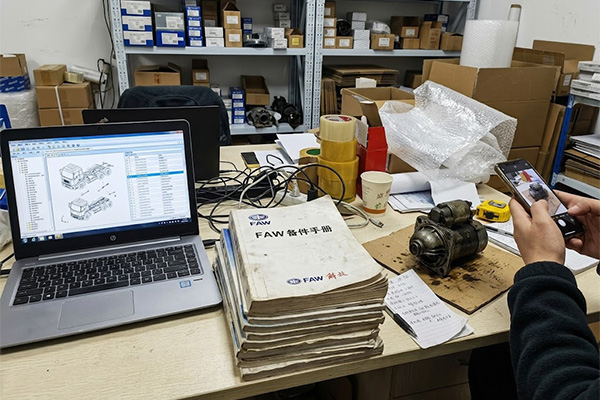
Path 1: OEM Electronic Parts Catalogs (EPC) Through Authorized Dealers
FAW maintains internal electronic parts catalog systems that authorized dealers and service centers use to look up parts by VIN or chassis number[5]. These are the most accurate references available because they are tied directly to FAW's production data.
Strengths:
- Highest accuracy for matching parts to specific trucks
- Updated with production revisions and superseded part numbers
- Includes exploded-view diagrams showing component relationships
Limitations:
- Access is typically restricted to authorized FAW dealers and service networks
- Interface and documentation are predominantly in Chinese
- International buyers rarely have direct access unless they work through a local FAW dealer in their market
- Availability of dealer support varies significantly by region
In our experience, buyers in markets with an established FAW dealer presence — such as parts of Africa and Southeast Asia[6] — sometimes obtain parts lists through their local dealer. However, many of our customers operate in markets where FAW dealer coverage is limited or where the dealer's parts inventory doesn't match their actual needs. For these buyers, the EPC is effectively inaccessible as a direct tool.
Path 2: Third-Party Parts Databases and Supplier Matching Tools
Several third-party platforms and industry databases aggregate parts information for Chinese trucks, including FAW[7]. Some suppliers also maintain their own internal cross-reference systems built from years of order data and parts matching.
Strengths:
- More accessible than OEM EPC systems — some are available online or through supplier portals
- May include cross-references between OE numbers and aftermarket alternatives
- Can cover multiple brands in a single lookup, useful for mixed-fleet buyers
Limitations:
- Accuracy varies significantly depending on the database's source data and update frequency
- OE numbers may be outdated, incorrectly mapped, or missing recent revisions
- Buyers still need a knowledgeable supplier to verify that a database match is genuinely correct for their specific truck
I've seen cases where a buyer found a part number through a third-party database, placed an order with a general supplier, and received a component that was dimensionally close but not an exact fit. The database wasn't wrong per se — it simply didn't capture a mid-production-year revision that changed the mounting specification. This is why we always recommend treating database results as candidates to verify, not confirmed matches.
Path 3: Direct Inquiry to a Multi-Brand Specialist Supplier
This is the path most of our international customers end up using — and, based on the inquiries we process, it's often the fastest route to a confirmed part for buyers who don't have dealer access or database subscriptions.
Strengths:
- Works even when the buyer's starting information is incomplete (a photo, an old part, a chassis number)
- The supplier handles the identification, cross-referencing, and availability check in one workflow
- Particularly effective for mixed or bulk orders across multiple FAW models
- Communication can be tailored to the buyer's language and technical level
Limitations:
- Quality of this path depends entirely on the supplier's FAW-specific expertise
- Not all suppliers can handle chassis-level identification or OE cross-referencing
- Requires trust in the supplier's verification process — buyers should ask how matches are confirmed
At Caanass, when a customer sends us a chassis number or a photograph of a worn part, our team cross-references it against our internal database of over 40,000 items and our accumulated order history with FAW components. We don't claim to replace an OEM EPC, but we can typically narrow the match faster than a buyer working alone with a third-party database.
| Path | Best For | Access Difficulty | Accuracy Level | Speed |
|---|---|---|---|---|
| OEM EPC (Dealer) | Buyers with local dealer relationships | High (restricted) | Highest | Varies by dealer |
| Third-Party Database | Buyers with technical knowledge and OE numbers | Medium | Variable — requires verification | Moderate |
| Specialist Supplier Inquiry | Buyers with chassis numbers, photos, or partial info | Low | High (with capable supplier) | Fastest for complex queries |
What Information Should You Prepare Before Searching for FAW Parts?
Many procurement delays happen before the search even begins — because the buyer starts with too little information or the wrong kind of information. Preparing the right reference data upfront dramatically reduces back-and-forth and ordering errors.
Before searching for any FAW truck part, gather at least one of the following: (1) the full chassis number (VIN) from the vehicle nameplate, (2) the OE part number from the existing component or previous order records, or (3) clear photographs of the part showing its shape, markings, and mounting context. The more data points you provide, the faster and more accurate your identification will be.
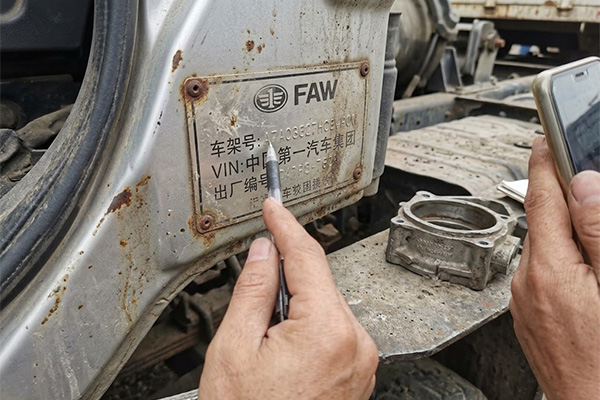
The Hierarchy of Useful Identification Data
Not all starting information is equally helpful. Here's how we rank the data points buyers provide, based on how quickly they lead to a confirmed match:
-
Chassis number (VIN): The single most valuable identifier. It ties directly to the truck's factory build specification and resolves most model, year, and configuration ambiguities.
-
OE part number: If you have the original manufacturer's part number — stamped on the part, printed in a previous invoice, or listed in maintenance records — this is the fastest route to reordering the exact same component.
-
Clear photographs: When neither chassis number nor OE number is available, a well-lit photo showing the part's shape, bolt pattern, connector type, and any visible markings can often allow an experienced supplier to identify it. Include a reference object for scale if possible.
-
Truck model and year: Helpful for narrowing the search but rarely sufficient alone due to configuration variations within the same model line.
-
Verbal description of the part: The least reliable starting point. Terms like "the rubber thing near the engine" or even "air filter" can refer to multiple distinct components depending on the truck's configuration.
A Practical Preparation Checklist
Before you contact any supplier or open any catalog, I recommend gathering:
- [ ] Chassis number — located on the vehicle nameplate, usually on the door frame or dashboard
- [ ] OE number — check the old part itself, previous invoices, or maintenance logs
- [ ] Photographs — at least 2-3 angles, including any stamped numbers or labels
- [ ] Quantity needed — for quoting accuracy
- [ ] Application context — is this a one-time repair replacement or a recurring stock item?
In our experience, inquiries that arrive with a chassis number and a photo are typically resolved in one communication round. Inquiries that start with only a model name often require 3–4 exchanges to confirm the correct part. That time difference matters when your truck is off the road or your customer is waiting for stock.
How Do Different Buyer Types Use FAW Parts References Differently?
Not every buyer needs the same thing from a FAW truck parts catalog. The way you use parts references — and which sourcing path works best — depends on your business model and operational needs.
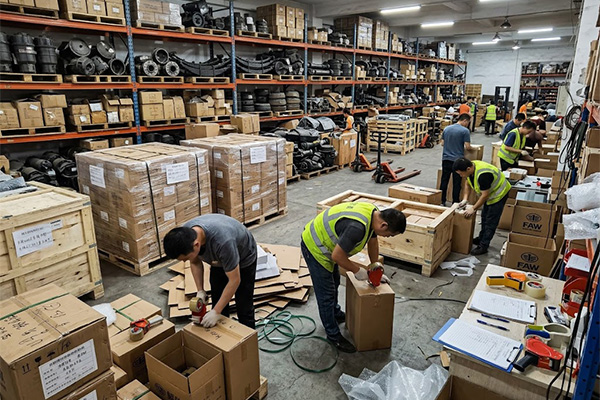
Fleet operators typically need maintenance BOMs (bills of materials) to plan preventive stock. Wholesalers need validated OE number lists to build inventory across FAW model lines. Repair shops and retailers need fast part identification — often from a symptom or a visual — with immediate availability confirmation. Recognizing your own use case helps you choose the right sourcing approach and avoid wasting time on references designed for a different buyer type.
Fleet Operators: Planning Stock to Minimize Downtime
If you operate a fleet of HOWO, SHACMAN, or FAW trucks, your primary concern is keeping vehicles running. You don't need to browse a full catalog — you need a curated list of wear parts and failure-prone components specific to the models in your fleet.
What works best:
- Provide your supplier with a fleet list (model, chassis numbers, mileage ranges)
- Request a recommended maintenance parts list with OE numbers and suggested reorder quantities
- Establish a recurring replenishment schedule rather than emergency ordering
At Caanass, we regularly help fleet customers in Africa and Southeast Asia build these maintenance BOMs. The initial setup takes some coordination, but it dramatically reduces per-incident procurement time and downtime cost over the fleet's lifecycle.
Wholesalers and Distributors: Building Inventory Breadth
Wholesalers need broad coverage across popular FAW models to serve their downstream customers. The catalog challenge here is different: you need a reliable mapping between OE numbers and actual available products — not just a list of what theoretically exists.
What works best:
- Work with a supplier who can provide product lists organized by truck model and system category
- Prioritize fast-moving parts categories (filters, brake components, suspension, engine wear parts)
- Verify OE number accuracy before committing to large stock orders — ask the supplier how they validate matches
- Consider mixed-container orders to test product accuracy before scaling
Repair Shops and Retailers: Speed of Identification
Repair businesses face a different pressure: a truck is in the bay, the customer is waiting, and you need to identify and source the correct part now. Catalogs are too slow for this workflow.
What works best:
- Send a photo and chassis number directly to a responsive supplier via WhatsApp or email
- Rely on suppliers who can confirm part identification within hours, not days
- Build a relationship with a supplier who understands your most common repair scenarios
The underlying point: A "catalog" means different things to different buyers. Recognizing what you actually need — a planning document, an inventory reference, or a rapid identification tool — will save you significant time and reduce the risk of ordering errors.
Frequently Asked Questions
Can I download a free FAW truck parts catalog online?
Some partial FAW parts lists and PDF catalogs circulate online, but these are rarely complete, current, or verified for accuracy. They may cover only specific model lines or outdated production years. Treat any free download as a preliminary reference and verify part numbers with your supplier before ordering.
How do I find the chassis number on a FAW truck?
The chassis number (VIN) is typically stamped on a metal plate attached to the truck's door frame, dashboard, or cab interior[8]. It may also appear on the vehicle registration documents. This number is the most reliable identifier for matching parts to your specific truck configuration.
Does Caanass provide a FAW parts catalog or parts list?
We don't publish a generic catalog because static lists cannot reliably represent the variation across FAW models and production years. Instead, we provide parts identification and matching services — send us your chassis number, OE number, or photographs, and our team will identify and quote the correct parts for your specific truck.
What if I only have an old part with no visible number?
Clear photographs are often sufficient for identification. Photograph the part from multiple angles, include any visible markings or stamps (even partial), and show the mounting area if possible. Our team can frequently identify components from visual reference combined with the truck model information.
How long does it take to identify a FAW part from a chassis number?
In our experience, straightforward identification requests — where the buyer provides a chassis number and specifies the needed component — are typically resolved within one business day. Complex requests involving multiple parts or unusual configurations may take 2–3 days for full verification.
Conclusion
The search for a FAW truck parts catalog is really a search for a reliable identification and sourcing process. No single document covers every FAW model, year, and configuration. The most effective approach combines the right starting information — a chassis number, OE number, or clear photographs — with a supplier who has the FAW-specific expertise to verify matches and confirm availability.
Whether you're a fleet operator planning maintenance stock, a wholesaler building inventory, or a repair shop solving an urgent breakdown, the path to the correct part starts with preparation and ends with a supplier you can trust to get the match right.
If you're sourcing FAW truck parts and want accurate identification without the guesswork, send your chassis number, part photos, or OE numbers to our team. We'll handle the matching, verification, and quoting so you can focus on your business.
📧 Email: grand@caanass.com 📱 WhatsApp: +86 19924698529
- [1]"FAW Jiefang", https://en.wikipedia.org/wiki/FAW_Jiefang. FAW Jiefang, the commercial vehicle division of FAW Group, markets several distinct heavy-duty truck platforms including the J6, J7, JH6, and various CA-series chassis configurations, each designed for different payload and application requirements. See FAW Jiefang official product documentation. Evidence role: general_support; source type: other. Supports: FAW Jiefang produces distinct truck series including J5, J6, JH6, and CA-designated models, each with different specifications and component architectures. Scope note: Model designations and availability vary by market; some series may have been discontinued or superseded in certain regions. ↩
- [2]"FAW Group", https://en.wikipedia.org/wiki/FAW_Group. FAW Group Corporation, founded in 1953 in Changchun, Jilin Province, is one of China's largest automobile manufacturers, producing a diversified range of commercial vehicles including heavy-, medium-, and light-duty trucks under multiple brand lines. See Wikipedia, 'FAW Group.' Evidence role: general_support; source type: encyclopedia. Supports: FAW Group Corporation manufactures a wide range of commercial vehicles including heavy-duty, medium-duty, and light-duty trucks. Scope note: Wikipedia provides a general corporate overview and may not reflect the most current model lineup or export-specific variants. ↩
- [3]"Importing a Motor Vehicle", https://www.cbp.gov/trade/basic-import-export/importing-car. Heavy-duty truck manufacturers routinely produce market-specific variants to meet destination country homologation requirements, including differences in emission standards, axle load regulations, electrical system voltages, and climate adaptations, all of which affect component specifications and parts interchangeability. See UNECE vehicle regulations framework and World Forum for Harmonization of Vehicle Regulations documentation. Evidence role: mechanism; source type: research. Supports: Commercial truck manufacturers produce market-specific variants to comply with local regulations, climate conditions, and infrastructure requirements, resulting in different component specifications across export markets. Scope note: This describes general industry practice for commercial vehicle exports; specific documentation of FAW's market-by-market variant differences is not widely published. ↩
- [4]"Parts Catalog Stakeholders - MOTOR Information Systems", https://www.motor.com/2022/11/parts-catalog-stakeholders/. Automotive aftermarket research consistently identifies parts identification accuracy as a primary challenge in commercial vehicle maintenance, with industry consensus that VIN-specific electronic catalog systems are necessary to manage the combinatorial complexity of chassis, powertrain, and market-specific configurations across modern truck platforms. See Frost & Sullivan and McKinsey reports on commercial vehicle aftermarket digitalization. Evidence role: expert_consensus; source type: research. Supports: The complexity of modern commercial vehicle configurations necessitates VIN-specific electronic parts catalogs rather than static universal references. Scope note: Industry research on parts catalog complexity is generally focused on global OEMs; direct studies specifically addressing Chinese truck OEM catalog fragmentation are limited. ↩
- [5]"China's Growing Role in U.S. Automotive Supply Chains", https://www.usitc.gov/publications/332/working_papers/id-19-060_chinese_auto_parts_final_080519-compliant_0.pdf. Chinese heavy-duty truck manufacturers, following industry practice established by global OEMs, deploy electronic parts catalog (EPC) systems within their authorized dealer networks to enable VIN-specific parts identification and ordering. These systems are typically restricted to authorized service points and are not publicly accessible. Evidence role: general_support; source type: other. Supports: Major Chinese truck OEMs including FAW maintain electronic parts catalog (EPC) systems accessible to their authorized dealer and service networks for VIN-based parts identification. Scope note: Direct documentation of FAW's specific EPC system is not widely available in English-language sources; this claim is supported by general industry practice rather than FAW-specific published evidence. ↩
- [6]"FAW Group", https://en.wikipedia.org/wiki/FAW_Group. FAW Group has pursued international expansion through truck exports and dealer network establishment in developing markets, with significant presence in Sub-Saharan Africa, Southeast Asia, and Central Asia, where Chinese heavy-duty trucks have gained substantial market share. See International Trade Centre export data and FAW Group annual reports. Evidence role: general_support; source type: research. Supports: FAW Group has established export operations and dealer networks in African and Southeast Asian markets as part of its international expansion strategy. Scope note: Dealer network density and service capability vary significantly by country; presence in a region does not guarantee uniform parts availability or service quality. ↩
- [7]"Hot sale parts catalog", https://www.chinatruck.cc/blog/Hot-sale-parts-catalog.html. The growth of China's commercial vehicle aftermarket has led to the emergence of third-party digital parts platforms and cross-reference databases that aggregate component data across multiple Chinese truck brands, though industry observers note significant variation in data quality, update frequency, and coverage completeness across these platforms. Evidence role: general_support; source type: other. Supports: Third-party aftermarket parts databases and cross-reference platforms exist for Chinese commercial vehicles, though their accuracy and completeness vary. Scope note: Specific third-party platforms are not named in this citation to avoid endorsement; the quality and reliability of individual databases should be independently evaluated by buyers. ↩
- [8]"Vehicle identification number", https://en.wikipedia.org/wiki/Vehicle_identification_number. ISO 3779 and ISO 3780 establish the international standards for Vehicle Identification Number (VIN) content and structure, while national regulations typically mandate VIN plate placement in accessible locations such as the dashboard, door frame, or cab interior for commercial vehicles. See ISO 3779:2009 'Road vehicles — Vehicle identification number (VIN) — Content and structure.' Evidence role: definition; source type: institution. Supports: Vehicle Identification Numbers (VINs) on commercial vehicles are typically located on a plate affixed to the cab door frame, dashboard, or other accessible location per international standards. Scope note: Specific VIN plate placement on FAW trucks may vary by model and production year; ISO standards govern VIN format rather than exact physical placement, which is determined by national regulations. ↩