Where Can I Find Suppliers of Chinese Auto Parts?
Sourcing Chinese commercial truck parts looks straightforward until you receive a shipment that doesn't fit. For buyers purchasing replacement parts for HOWO, SHACMAN, FAW, FOTON, or DONGFENG trucks, the real problem isn't finding a supplier — it's finding one who can correctly identify, stock, and ship the exact part your vehicle needs. The wrong supplier costs you more than the price difference.
The short answer: Chinese commercial truck-parts suppliers are reachable through B2B platforms like Alibaba, through direct Google searches leading to specialist supplier websites, through trade shows, and through referrals. But the channel you use matters far less than what you verify before placing an order. A supplier's ability to confirm OE number compatibility for your specific truck model and year is the single most important factor[1] to evaluate — before price, before lead time, before anything else.
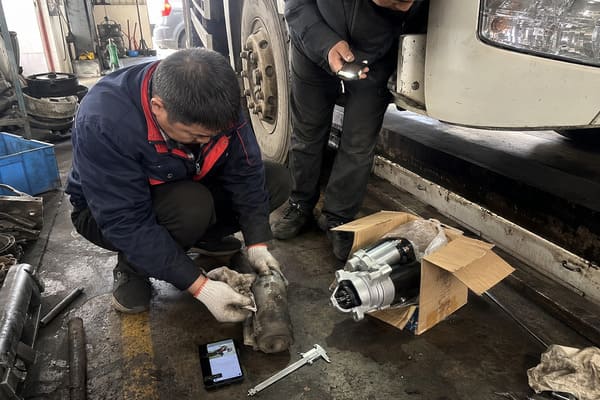
Most buyers I speak with have already browsed Alibaba before they contact us. Many have already received one wrong shipment. The channel question is worth revisiting — but the verification process is what actually protects your procurement.
Does the "factory vs. trader" question actually matter?
Many buyers enter their first sourcing conversation asking whether a supplier is a factory or a trading company. The assumption is that factories are more reliable or offer better pricing. In commercial truck parts, this framing is almost always the wrong starting point.
For Chinese commercial truck replacement parts, no single factory covers all makes, models, and part categories. A supplier who can reliably identify and fulfill parts across HOWO, SHACMAN, FAW, FOTON, and DONGFENG — across engine, brake, transmission, suspension, and electrical categories — is more valuable than a factory with a narrow SKU range and no cross-model matching capability.
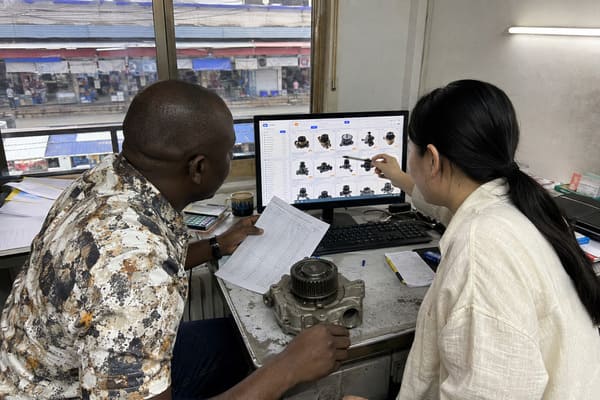
Why specialization matters more than supplier type
The commercial truck parts market in China is fragmented by design. Different manufacturers use different part standards, different OE numbering systems, and sometimes different specifications for the same part category across model years. A supplier who sells HOWO engine parts doesn't automatically carry compatible parts for a SHACMAN of the same tonnage.
In my experience handling buyer inquiries at Caanass, the most common sourcing problem isn't price — it's a mismatch between what the buyer described and what the supplier actually stocked[2]. This happens most often when:
- The buyer describes the part category without providing the truck model and year
- The supplier confirms availability based on a general description, not an OE number
- The part ships, doesn't fit, and the buyer absorbs the cost of return shipping and downtime
A specialized trading company with broad catalog coverage and established supplier relationships across multiple Chinese truck brands can often solve this problem better than a single-brand factory. The right question to ask isn't "are you a factory?" — it's "can you confirm OE number compatibility for my specific truck model and year before I place an order?"
What broad catalog coverage actually means
When I describe Caanass as covering more than 40,000 SKUs across HOWO, SHACMAN, FAW, FOTON, and DONGFENG, I'm pointing to something specific: the ability to identify and source parts across engine, brake, transmission, suspension, steering, electrical, cabin, body, filter, and maintenance categories — for multiple brands — from a single point of contact. For a wholesaler building a mixed container order, or a fleet buyer who operates more than one truck brand, this consolidation has real procurement value.
A single-brand factory cannot offer this. A generalist marketplace seller usually can't verify it. This is the gap that a specialist supplier is designed to fill.
Are B2B platforms like Alibaba a reliable place to find truck-parts suppliers?
Alibaba and similar platforms are where most international buyers start their supplier search for Chinese auto parts. They offer real access to a large number of suppliers and make initial contact easy. But for commercial truck parts specifically, platform browsing has significant blind spots.
Platform listings are built for visibility, not for parts compatibility. A supplier can list "HOWO truck parts" without demonstrating any capacity to match specific OE numbers, vehicle model years, or application-specific specifications. Buyers who rely on keyword search alone often end up in conversations with generalist sellers who can't verify fitment.
What platforms do well — and where they fall short
| Evaluation Factor | Platform Strength | Platform Weakness |
|---|---|---|
| Supplier volume | High — many options visible | Hard to filter for specialists |
| Initial contact | Easy messaging and RFQ tools | No signal on OE matching capability |
| Price comparison | Straightforward | Price without fitment context is misleading |
| Verification | Trade Assurance, Gold Supplier badges | Does not confirm parts-identification depth |
| Model compatibility | Not systematically available | Buyer must ask explicitly |
Based on inquiries we handle, buyers who contact us after a platform search frequently share the same experience: they found several suppliers, received competitive quotes, chose one based on price or response speed, and received parts that didn't fit — or received a different part number than requested with no explanation.
What to ask a platform supplier before ordering
If you are evaluating a supplier found through a B2B platform, treat the first conversation as a verification exercise, not a price negotiation. Ask:
- Can you confirm the OE number for this part? Provide your truck model, year, and part description. A reliable supplier will give you a specific OE number in response.
- Do you have this part in stock, or is it sourced on order? This affects lead time and your ability to replenish reliably.
- Can you support mixed orders across part categories? Relevant if you need to consolidate multiple part types in a single shipment.
- What is your process if a part doesn't fit? A supplier with no clear answer to this question is a procurement risk.
Platforms are a valid starting point. They are not a sufficient endpoint for commercial truck parts procurement.
Is searching Google for a supplier's own website a better signal?
In my experience, this channel is underused by international buyers — and often gives the clearest signal of supplier specialization. A supplier who has invested in a structured product website, with coverage pages organized by truck brand and model, OE number references, and part category breakdowns, has made a commitment that generalist traders rarely do.
A detailed supplier website organized by vehicle application — listing HOWO, SHACMAN, FAW, FOTON, and DONGFENG parts by system and OE number — tells you something a platform listing cannot: this supplier has operational depth in this product category.
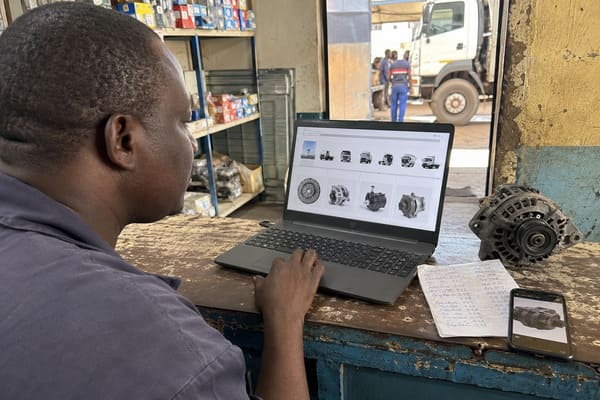
How to read a supplier website as a procurement signal
When evaluating a supplier website found through direct search, look for:
- Truck model coverage pages — Does the supplier list specific models (e.g., HOWO A7, SHACMAN X3000, FAW J6) rather than just brand names?
- OE number references — Are part numbers listed? Cross-referenced with applications?
- Part category depth — Does the supplier cover engine, brake, suspension, electrical, and cabin parts — or only one or two categories?
- Company background and warehouse information — A supplier with a documented warehouse operation and team size is more accountable than an anonymous listing.
- Inquiry process — Is there a clear process for submitting your truck model and part requirement and receiving a confirmed OE number back?
This is not a guarantee of supplier quality — no channel is. But a supplier who has built this kind of infrastructure is more likely to have the catalog knowledge and stock management to fulfill a complex or recurring order correctly.
What is the correct process for verifying parts compatibility before ordering?
This is the most actionable part of the buying process, and the step most often skipped by buyers who contact us after a failed first order. Price negotiation should not happen before OE number confirmation. Full stop.
The correct process for sourcing commercial truck replacement parts from a Chinese supplier follows a specific sequence. Skipping steps increases the probability of receiving an incompatible part.
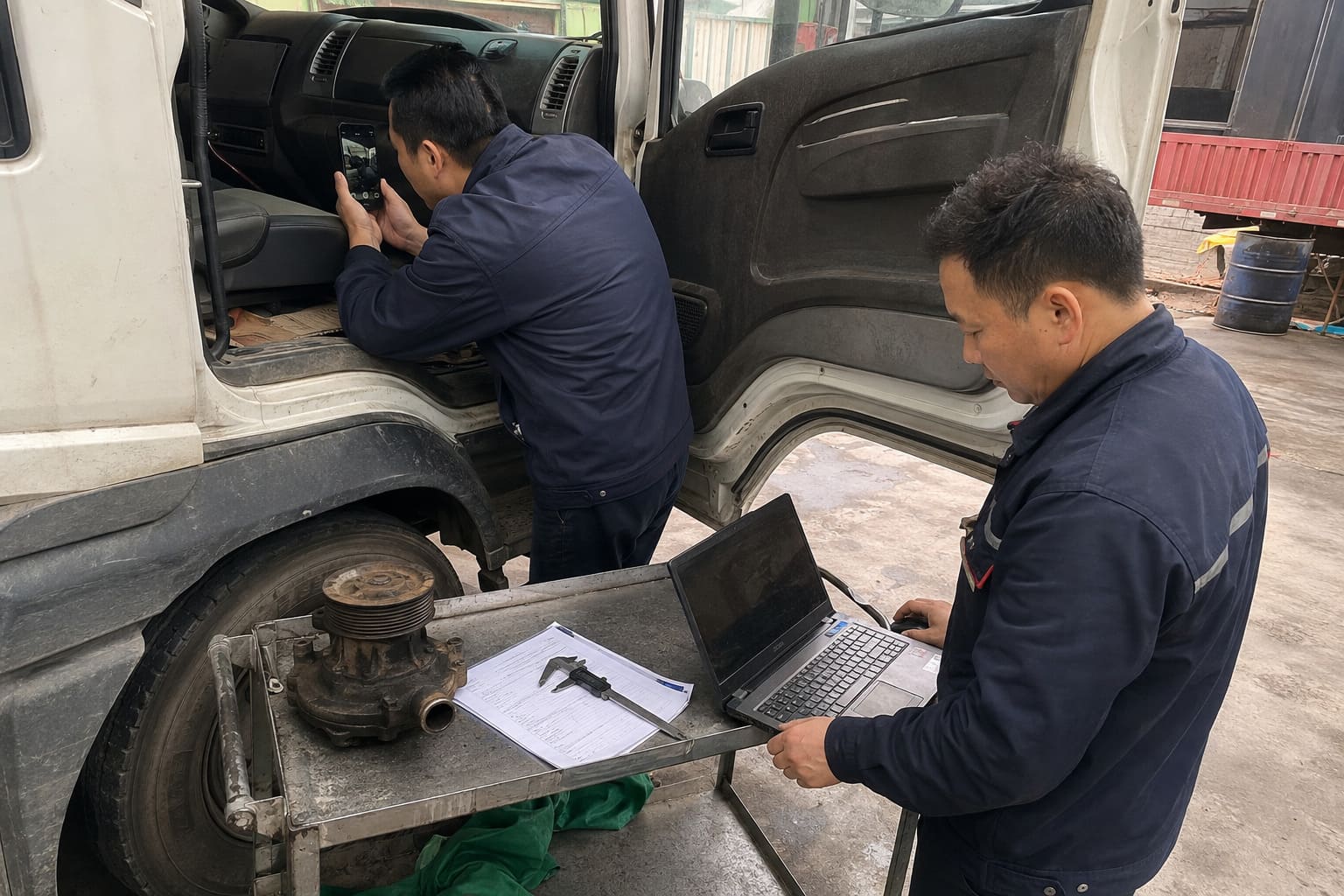
The verification sequence, step by step
Step 1: Provide complete vehicle information
Do not describe a part by function alone ("I need a water pump"). Provide:
- Truck brand and model (e.g., HOWO T7H, SHACMAN M3000)
- Model year or production date
- VIN number if available[3]
- Existing part number from the old part label, if visible
- Any photos of the part or installation position
The more information you provide, the more accurately a supplier can confirm compatibility. In our inquiry process, we ask for this information before generating any quotation.
Step 2: Receive OE number confirmation from the supplier
A reliable supplier responds with a confirmed OE number — the manufacturer's original part number — matched to your truck model and year. This is the checkpoint. If a supplier quotes a price without confirming an OE number, the risk of incompatibility is real.
Step 3: Cross-check the OE number if possible
If you have access to a parts catalog for your truck model, verify that the OE number matches what the supplier has confirmed. Discrepancies at this stage are worth resolving before placing an order.
Step 4: Confirm stock status and lead time
Ask explicitly whether the part is in stock or sourced on order. For fleet buyers managing preventive maintenance schedules, lead time accuracy is as important as price.
Step 5: Place the order with documented OE number confirmation
Ensure the confirmed OE number is documented in your purchase order or order confirmation. This creates a reference point if the part arrives with any discrepancy.
This process takes more time upfront. It saves significantly more time — and money — downstream.
What does a specialist supplier look like in practice?
At this point, I want to offer a concrete example rather than an abstract description. Caanass, the truck-parts brand of Guangzhou Grand Auto Parts Co., Ltd., is the operation I work within — and it's a useful reference for what a specialist supplier looks like compared to a generalist marketplace seller.
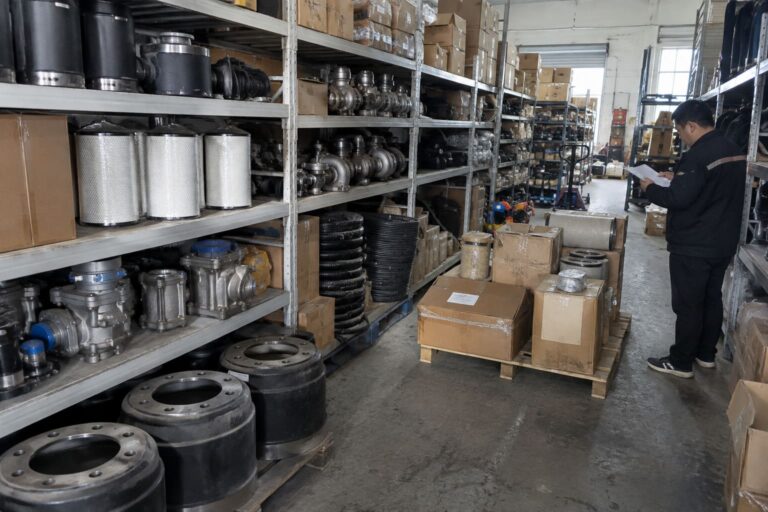
Caanass focuses specifically on replacement parts for HOWO, SHACMAN, FAW, FOTON, and DONGFENG commercial trucks[4]. Our catalog covers more than 40,000 items across engine, brake, transmission, suspension, steering, electrical, cabin, body, filter, and maintenance categories. We operate an 8,000 m² warehouse in Guangzhou and handle parts identification, OE number matching, multi-brand sourcing, and consolidated shipping for international buyers — including mixed-order and container-order consolidation.
What this means in practice: when a wholesaler contacts us with a list of parts across three truck brands, we can identify OE numbers, confirm stock, consolidate the shipment, and coordinate export logistics from a single point of contact. That's the operational profile a buyer should look for — regardless of which channel they use to find us.
I'm not suggesting Caanass is the only supplier worth evaluating. I'm suggesting it's a useful benchmark for the kind of capability that solves the parts-identification problem reliably.
Frequently Asked Questions
How do I know if a Chinese truck-parts supplier can handle my specific truck model?
Ask directly before requesting a quote. Provide your truck brand, model, year, and any existing part numbers. A capable supplier will confirm an OE number for your application before discussing price. If a supplier skips this step, treat it as a warning sign.
Is it better to source from a factory or a trading company for commercial truck parts?
For commercial truck parts covering multiple brands and categories, a specialized trading company often provides broader catalog coverage and more reliable OE matching than a single-brand factory. The key evaluation is whether the supplier can identify and fulfill your specific parts — not their business type.
What information should I include in my first inquiry to a Chinese parts supplier?
Include your truck brand and model, model year or production date, the part name or category, any existing part number from the old part label, and your order quantity and frequency. Photos of the part or installation position are also helpful. This allows the supplier to confirm OE compatibility before quoting.
Can I consolidate parts for multiple truck brands into one order?
Yes — if the supplier has multi-brand coverage. Before assuming this is possible, confirm that the supplier stocks parts for each of your truck models and can combine them into a single shipment. Not all suppliers have this capability. For buyers operating mixed fleets of HOWO, SHACMAN, FAW, or FOTON trucks, this consolidation can significantly reduce per-unit logistics costs.
Are Chinese truck parts certified or OEM-grade?
This varies by supplier and by part. Do not assume all Chinese truck replacement parts carry specific certifications or OEM status. Ask your supplier to specify the quality tier and certification status for each product line you intend to purchase. Verify documentation for any certification claims before relying on them in your procurement process.
Conclusion
Finding suppliers of Chinese auto parts — specifically for commercial trucks — starts with the right channel but succeeds only with the right verification process. B2B platforms provide exposure; direct supplier websites often signal deeper specialization; and referrals from other buyers in your market carry experience-based credibility. But none of these channels protect you if you skip OE number confirmation before placing an order.
The core principle: provide your truck model, year, and part details first. Get OE number confirmation before discussing price. Choose a supplier with catalog depth across the truck brands you operate — not just the cheapest quote you received.
If you source parts for HOWO, SHACMAN, FAW, FOTON, or DONGFENG trucks and want to discuss your specific requirements, contact the Caanass team directly. We'll start with your truck model and part details — and give you an OE-confirmed quotation before anything else.
- [1]"OEM Component Sourcing in Automotive World", https://www.mechanicalpower.net/blog/auto/oem-component-sourcing-in-automotive-world/?srsltid=AfmBOoqzrHeH8ViTLUqyYuWiHGQF0HfZ3pNAQS3NXCgApssYg8Hjl850. Industry standards bodies such as the Auto Care Association and the Automotive Aftermarket Suppliers Association have emphasized OE part number cross-referencing as a foundational compatibility verification step in aftermarket procurement guidelines. Evidence role: expert_consensus; source type: institution. Supports: OE part number matching is an established best practice in automotive aftermarket procurement for ensuring fitment compatibility. Scope note: These guidelines primarily address the North American and European aftermarket; their direct applicability to Chinese commercial truck sourcing contexts is implied rather than explicitly documented. ↩
- [2]"Impact of Currency Volatility in the Automotive Import-Export ...", https://commons.clarku.edu/cgi/viewcontent.cgi?article=1008&context=mpasl. Studies on automotive aftermarket supply chain quality have identified incorrect parts fitment as a leading cause of procurement inefficiency and return costs, attributable to inadequate parts identification at the point of ordering; see relevant automotive supply chain quality literature. Evidence role: general_support; source type: research. Supports: Parts incompatibility and fitment errors are a documented and significant source of cost and disruption in aftermarket automotive parts procurement. Scope note: Empirical research quantifying this specifically for Chinese commercial truck parts imports is not readily available in the open literature; general automotive aftermarket findings are applied here by analogy. ↩
- [3]"VIN Decoder", https://www.nhtsa.gov/vin-decoder. The ISO 3779 standard defines the structure of the Vehicle Identification Number (VIN), which encodes World Manufacturer Identifier, vehicle descriptor, and vehicle identifier sections; this information is used by parts suppliers to cross-reference fitment compatibility. Evidence role: definition; source type: institution. Supports: Vehicle Identification Numbers encode manufacturer, model, and production-year information that can be used to identify correct replacement parts. Scope note: Chinese commercial truck manufacturers may apply VIN conventions differently or use additional national standards; buyers sourcing for Chinese-manufactured trucks should confirm with the supplier how VIN data is used in their catalog lookup process. ↩
- [4]"Category:Truck manufacturers of China", https://en.wikipedia.org/wiki/Category:Truck_manufacturers_of_China. Chinese commercial vehicle production statistics published by the China Association of Automobile Manufacturers (CAAM) identify Sinotruk (HOWO), FAW, Dongfeng, SHACMAN, and FOTON as among the leading heavy truck manufacturers by unit output. Evidence role: statistic; source type: institution. Supports: HOWO (Sinotruk), SHACMAN, FAW, FOTON, and DONGFENG represent major segments of Chinese heavy and commercial truck production and are among the most widely exported Chinese truck brands. Scope note: Market share data fluctuates year to year; figures should be verified against the most recent CAAM annual report for the period in question. ↩